


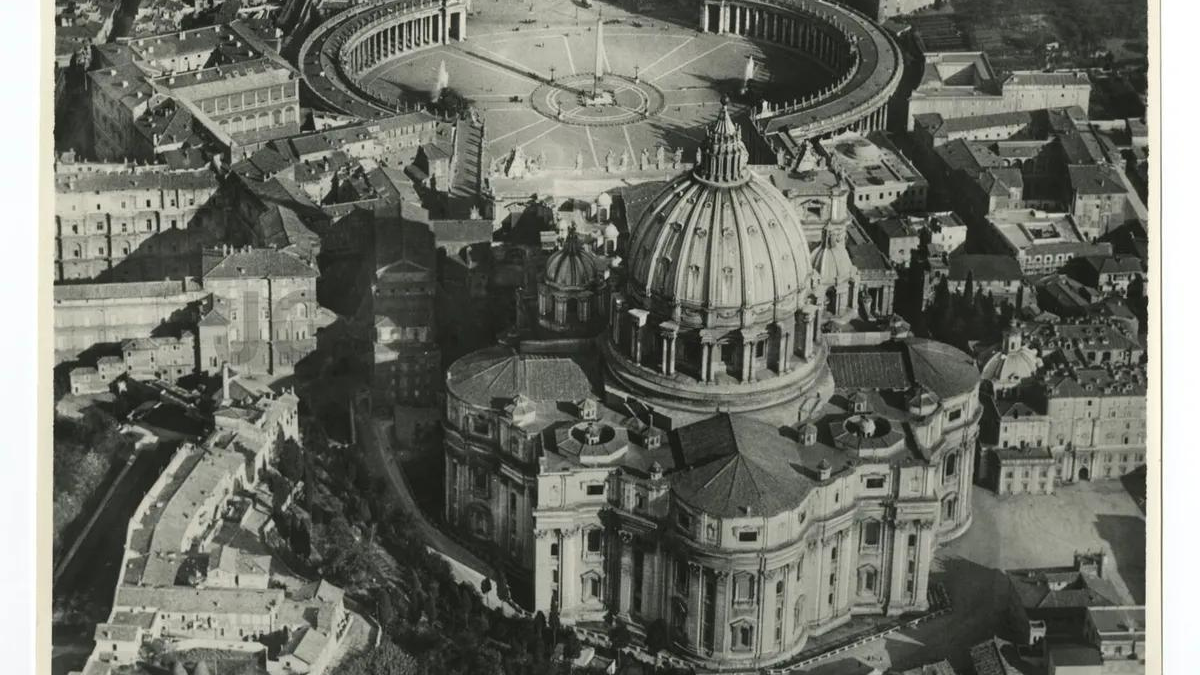
What is the smallest nation in the world? San Marino? Andorra? Monaco? No… it’s the Vatican City – the seat of the Roman Catholic Church. This particular state is unusual for more reasons than its size – less than a square kilometre with a population of about 1,000. It did not exist until the Lateran Treaty of 1929. Technically, it is a separate ‘country’ but is has no armed forces, no physical border controls (even though it issues its own passports) and no airport (even though it issues airmail stamps). Despite this, it has the official status of a country and all the diplomatic perks that go with this including a seat at the United Nations – something enjoyed by no other religious denomination – whether Christian or non-Christian. Naturally its leader the Pope is not only a cleric but also a head of state.
How did this political and historical anomaly come into existence? It owes its origins to the politics and nationalist movements of nineteenth century Europe. Before the 1860s, the nation of Italy did not exist as a political union but was patchwork of different minor states and kingdoms. Gradually these were united under the Sardinian monarchy. This unification meant the Pope would inevitably lose control of his independent kingdom – the papal states. Naturally the popes resisted Italian unification but gradually lost all their territory including Rome itself by 1870 and with it any semblance of temporal power. The pope reacted by refusing to recognise the state of Italy and all subsequent popes followed suit isolating themselves in their Vatican palaces well into the twentieth century.

Lateran Treaty of 1929
Then in 1929 Pope Pius XI signed the Lateran Treaty which resulted in the pope regaining some prestige as a head of state by creating a de facto one within the city of Rome. It was Benito Mussolini – the then head of the Italian government – who sought to have his regime officially recognised by the catholic church, the dominant religion of the country. He was prepared to pay in the vicinity of $80,000,000 at the time for this recognition. This amount was technically compensation by Italy for the loss of the Papal States. What makes this deal rather ‘unsavoury’ is that Mussolini was the number one ally of Adolf Hitler – the German dictator who triggered World War II in Europe.
Through this Lateran Treaty, the Roman Catholic Church gained enormous wealth and the prestige that comes with being recognised internationally as an independent state. As a result, it gained privileges that no other religious organisation has. All subsequent popes have ruled as absolute (if rather limited) monarchs and have clung to the privileges that separate statehood gives them. One of these is the Vatican Bank an institution that allows enormous amounts of money to pass through it unregulated except by a select group of Roman catholic clerics and their appointed officials.
The Christ of the New Testament was reputed to be a man of humble origins who lived a rather modest life – at least materially. Yet the man who refers to himself as the vicar of Christ in the modern world has control of enormous wealth – the extent of which is effectively concealed from the rest of the world. Moreover, this situation came about by a deal with a fascist dictator. While it might not have been a deal the the ‘Devil’, it certainly was one with a rather crooked character. (What does the Bible say about selling one’s soul for thirty pieces of silver? Is there a parallel here?).

Vatican City Flag
Clearly, the recognition by the Holy See was bought albeit at a very high price – something which taints both parties in the transaction. The anomaly of the Vatican City State is the result of a deal between a Fascist dictator to have his regime recognised and a church that sought to regain some of its earthly power, prestige and medieval privileges. In this context, it is less of a state than the product of political expediency and uncomfortably obvious vested interests.
This is something to be considered whenever the Pope makes any supposedly infallible pronouncements about human morality. It is an interesting coincidence that in the very year the pope lost his last vestige of political power – control over his lands the Papal States – he proclaimed the doctrine of papal infallibility. As if formalising one form of authority (the spiritual and religious) was compensation for losing another (political control over territory). While the concept of papal infallibility had existed as a general concept for centuries, it was not made offical until 1870.
Whatever its status the authority of the pope and the legitimacy of the Vatican as a state, it is undoubtedly tainted by its origins.