


Love is not the way to treat a friend. Richard Brautigan said that at least, and if I think with what I assume is sense, I think this is true. Love, or lust or like or limerence, is probably not the way to treat anyone. To love is to fill your fogo bin with good feelings and the skip bin with bad ones. I’m not so sure the bad is outweighed. How many great people do you lose to love? It is very rare for things to end well, unless you walk off a cliff at the same time. Maybe the best ending you can hope for is apathy; but still, love is a thought that keeps me occupied, and when it does, it makes everything else lack substance.
CONFESSIONAL, an all-caps play by Alice Schlipalius and Penelope Gordon, is a sharp breezy comedy about romantic disappointment. Through a series of interlinked vignettes, the big cast of characters wrangle their way through various forms of unrequited love. While each situation is comically heightened into ridiculousness, the feelings that underscore each scene ring true. One loves the other too much and the other not enough.
One character wants to take his very casual relationship to the next level, but can only express his love by emulating grand gestures seen in romantic movies. The other recoils and cuts him off; not because she doesn’t like him, but that she can’t bear to be turned into a phantasy object. Another character makes herself a doormat for a pampered film bro who can’t even spare her a single rat’s ass. Another girl is in love with her friend who happens to be in a relationship. When the rival partner is finally out of the way, taking a bed in a mental hospital, she pounces on the situation to take advantage. Frustrated desire makes each character act awkwardly or irrationally or immorally. Some of it is relatable, some very barbaric.

CONFESSIONAL.
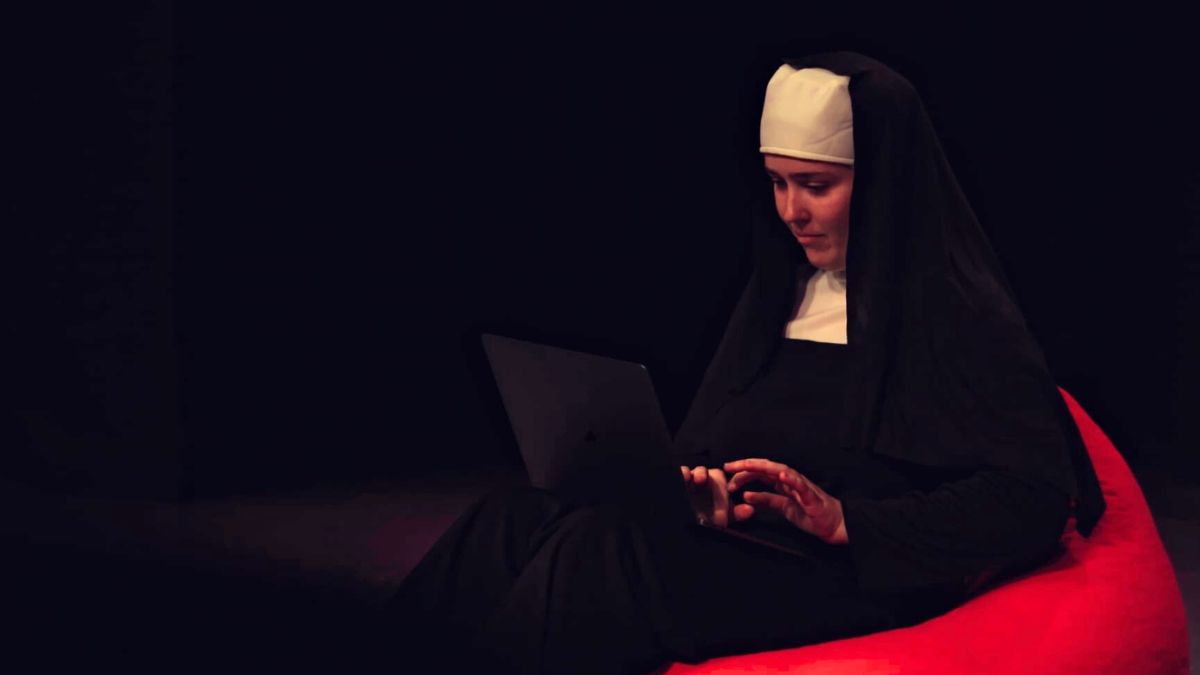
The most barbaric was the nun, played by Jaz Hosken. The first scene, she doesn’t speak at all; she just sits in a beanbag, typing on a laptop. But from her pauses and facial expressions, we somehow realise that what she is typing is erotic fanfiction. This was my favourite scene, I don’t know how she did it, the subtlety was broken in her next scene. In a graphic and randy monologue, it is revealed that the object of the nun’s smut-fic is God Himself, and the next thing you know, the nun is miming a very pornographic act and slandering the good Lord’s honour, accusing Him of being selfish in the bedroom. Although the scenes with the randy nun were memorably shocking in a South Park way, the gaudy lampoon of religious hypocrisy felt pretty out of place. The rest of the scenes were grounded in the everyday, their appeal being their baseline relatability. Having a randy nun in this kind of play is like casting Mr Bean in an episode of Friends.
While the play’s title CONFESSIONAL does allude to the randy nun’s choice religion, the poster’s typography is much more likely to remind one of highschool sleepovers or the sealed section of a Dolly Magazine. Throughout the play are interludes where the actors stand and recite the audience’s anonymous confessions. I was expecting the stories to be funny or ‘spicy’, but they were much more like the secrets told later in the sleepover when most people have gone to sleep: mildly traumatic and laden with guilt. We all have a dog-act that haunts us from the junk drawers of the mind. In the pursuit of love, everyone has done or will do something that makes them question their status as good. Sure you need self love, you need it to love at all, but we don’t give enough credit to constructive self hate. A dog-act is a problem, but a dog-act that’s a pattern? That’s dog. You hope the people who must confess can have the time and space and guts to resolve, not absolve.

CONFESSIONAL.
But I haven’t yet said what I love about this play: the stage management! The short scenes transition so seamlessly. The characters and props are there one second, replaced with new ones the next. It is organisational magic. Sometimes an actor will leave the stage and return a moment later completely different; clothes, hair, makeup and everything. I was shocked to see merely six actors bowing at the curtain call. Until the end, I thought the three characters played by Henry Freeman-Dick were played by three different dudes. There was also a clever use of diegetic sound and beanbags. Who knew a beanbag could be sat on in so many different situations? I was also impressed by the physical comedy; the great scene being Chloe McShane trying to cut Lucy Nunn’s hair. The latter is in the midst of an impassioned rant and keeps flicking her hair before the scissors can catch. Watching this push-pull interplay between the hair and scissors is like watching a parkour compilation first thing in the morning. I know this is not a good simile, but I cannot comprehend the acrobatics.
Watching these characters scratch and chase and howl at their unmet desires, either becoming weird, or manic, or mentally ill, I kept thinking of the word affection as defined by Ambrose Bierce: “addicted to being a nuisance […] The most affectionate creature in the world is a wet dog”. Who wants a wet dog’s affection? And who wants to gift it? Worse, who wants to be seen as a wet dog? To think or hope they are a cool dog. but then find out they are a wet dog? Anyone can become a wet dog. It is not a dog-act, but it feels so bad! This is why I think love is probably not the way to treat a friend. Most situations in the play do not end well, with the exception of two stilted characters who, after various mortifications, talk and figure it out.