


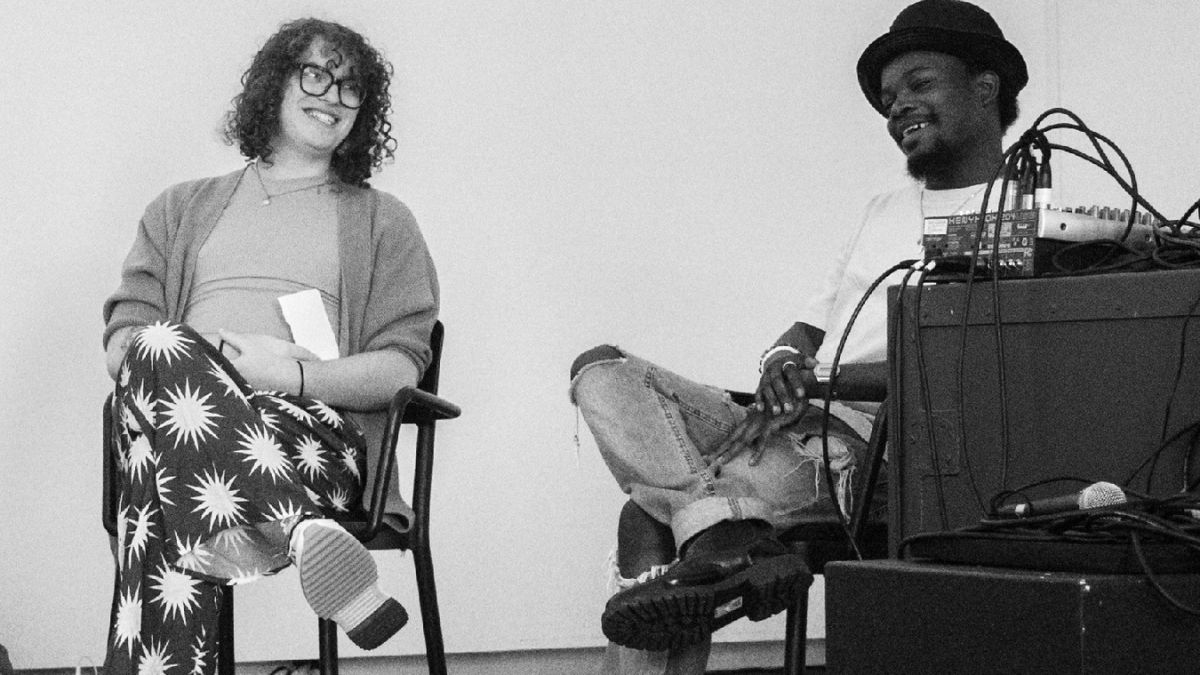
Within the halls of the Goolagatup Heathcote Gallery this past September/November echoed the debut sound installation of Nigerian-born, Boorloo-based artist Mohammad “Ayo Busari’, Home Frequencies: Ẹ káàbọ̀, put on as a part of the Melville Contemporary commission. The work was a touching reflection of the tumultuous diaspora Ayo has experienced and the impact that has had on their identity, expressed through sound collage and poetry, with twinges of both Steve Reich and afro-beat.
I had the delight to sit down with Ayo (A) and his collaborators Tao Issaro (T), Becca Attwood (B), and Naoko Uemoto (N) amongst a small crowd to discuss his work, practice, and home.
Would you like to all introduce yourselves?
A: My name is Ayo, I’m an artist, and I just love creating art and putting smiles on people’s faces.
T: I’m Tao, I’m a performance maker and musician. Same as Ayo, just in it for the passion and making my way through this journey called life.
B: I’m Becca, I use they/them pronouns. Again, a performance maker, musician—a lot of my work revolves around social justice and queer ecology.
N: I’m Naoko, I do similar music and performance-y things.
How did this project begin?
A: I’m not from this land, I’m from Nigeria. This is the third country that I am living in. I’m always trying to figure out what ‘home’ means for myself—I can barely remember what my ‘home’ looks like and feels like. This work has been a way for me to remember.
A: I was blessed to be reached out by Lyndon Blue and the Goolagatup team. They asked if I wanted to be a part of this amazing exhibition coming up, and it sounded like a good opportunity to test out this work I’ve had in mind for a while. It was a chance to experiment with sound-things that I wouldn’t normally do; it mixes my usual contemporary work into something more experimental in an effort to find a place where people can come in and sit with one another.
You’ve had this idea stirring around a while before approaching it as an installation, has it changed since its original conception?
A: Because it’s the first ‘sound-work’ I’ve done, it’s been very fun but stressful! Thankfully, I got to work in a residency here for about two weeks, and I got about 70% of the work recorded and figured it out there. I got Tao to come in and record percussion, I got Naoko and Becca to come in, and Alyssa (Dalao) and Jarrad on vocals, and Angelo (Ravina) on keys. Recording the music here and now presenting it here feels very full-circle.
A: I see this installation as this jam session almost. The four speakers in each corner are like four different people jamming, bringing different aspects of a shared sound together. I think about speakers like this in DJ settings too. It has been very interesting navigating the installation space, and what should go in each of these speakers, it’s very different to mixing a stereo track, a lot more investigating the space. I do keep in mind that how we express and receive sound in relaxing rooms with four speakers to a crowd at a DJ set to someone wearing stereo headphones is so different–there’s a full experience in each of those, and something so unique too.
Talking about physical space and sound, in the writing about (and title of) the work, you reference the frequencies and the physics of sound as it responds to space. How do you think this space specifically (the Gallery Project Space) reacts to the sound?
A: It definitely makes me feel calm…I think the bean bags in the space help as well. I’ve stopped many times working on this feeling properly tired. It’s a nice, calm space, and I find myself so relaxed and at peace listening to it. It offers something that I don’t get in my other work, even at the Goolagatup Sounds opening night, which was also spatial. I think this space in itself gives it a homely, interconnected vibe that you can’t get from any other space.

Photo credit: Julie Ziegenhardt
How has the collaborative aspect of this show emerged? There’s a lot of different voices in the recordings, how do you go about approaching it?
A: I love collaborating on projects: I guess this work is listed as ‘by solo artist Ayo Busari’, but it’s never really a solo work because I love working with people, it really brings me joy. A lot of the collaborators that I work with are also not from this land–a lot of diasporic artists too–because we have a lot of shared similarities in that sense.
T: Also, Ayo is a real community builder. I know from my own personal experience that Perth can feel sort of isolating for multi-cultural artists due the serious lack of representation–I felt isolated for a very long time, but Ayo has this way of bringing people together, and it’s been a real privilege. Through meeting him, I feel more connected to this beautiful, multi-cultural Australia than I ever have before…it’s a real strength of Ayo’s.
To the collaborators, this show is quite aligned with Ayo’s personal experience with diaspora and home, but I have the feeling that you all brought some of your homes into this project as well. How has that process been?
B: I think Ayo’s way of working is interesting and inspiring to me, because it’s inherently decolonial; I’ve recorded stuff before where it’s just been sheet music, but Ayo brought me in and said “okay, start singing”. It’s very much based on impulse and vibes, it’s almost like somatic therapy, or at least that’s what it felt like. And it’s working in that way that takes me back to my roots: that’s how my ancestors made music. I also really resonated with the lyrics questioning your sense of belonging in this place, because, as immigrants, like we moved here for a reason, but finding that community, and hoping that people both understand and find that shared language is difficult.
N: The experience of recording with Ayo has been quite freeing: in some contexts the things I play feel amateur, but knowing and trusting that Ayo will turn it into something cool is just comforting. Like just three notes repeated would feel weird, but I trust that Ayo has a different sense of rhythm to make something not generic.

Photo credit: Julie Ziegenhardt
T: When Ayo approached me, he gave me a general rundown on what he was going for. There were some sections in the scratch track where the ideas were more formulated, and then there were other sections with absolutely nothing, where Ayo just asked “what do you feel like doing here?”, adding to what Naoko said. It’s very interesting how Ayo drives the narrative, but I still feel like I (and the rest of the musicians) have a say in the art itself–the vision wasn’t ours, but we were still making it together…from nothing, from the ether, in situ!
A: —and sometimes, I would ask you to play something and you would say “hey, what do you think about this instead?” and I often respond with “Oh actually I liked that better!”. Like my collaborators, I’m also quite flexible when it comes to suggestions; prioritising the best idea over my idea, having that dialogue, it’s really nice.
(Audience Question) How do you start your process at the very beginning?
A: I know the topic that I want to work on, like I know that this is going to be about my ancestors, and that guides me. Then I just start messing around on my MIDI Keys, or I grab a sample, and I record little voice notes of me playing around with layers of sounds. Anything I can play myself I do, and everything I can’t I ask around.
(Audience Question) When you make from a personal place, and you kind-of cannibalise yourself and your culture to make work, how do you leave it in the room and go on with your day, if you do at all?
A: There’s that saying: Make work from your scars, not your wounds. Before I put out anything, I make sure I’m comfortable and okay enough to share it. A lot of things I’m making now have taken me years to heal and become comfortable enough to bring something to the room. The things I’m going through now I’ll make art about in a few years, not now, because I’m still healing those scars.
This whole work is about the sonic qualities of what we call ‘home’. If you would indulge me in a cheesy question to end the interview, what sound immediately evokes ‘home’, whatever that means to you?
T: The rain on a roof…it takes me back to my oldest memories. I’m not exactly sure why, but every time I hear it I’m transported back to five-year-old Tao.
1: The sound of Yoruba… that’s what we speak in my house. My mum’s voice especially.
2: Going back to my oldest memories, the sound of a street vendor yelling. Back in the home that I grew up in in the Philippines, there was this man who walked around with these two massive buckets of this brown sugar dessert called Tahô, and he would just scream “TAHÔ!”, and that’s home.
3: I’m South African, and where I’m from, we speak Khoisan (notable for its clicking consonants), and there’s something comforting about hearing clicks from home, because the clicks are so much more than just clicks.
N: I think of footsteps that you’re really familiar with, to a point where you can tell how they’re feeling just from the way they walk.
A: I think footsteps as well, especially as they walk to my room. If it’s my mum for example I need to wake up.

Photo credit: Aaron Claringbold
The exhibit has come and gone, but I hope you’ve enjoyed this retrospective on the work and creative process of one of Boorloo’s burgeoning creative forces. Make sure to catch Ayo at the top of the new year with his new theatrical work better late, than never with the newly conceived Blue Joy Theatre Company.