


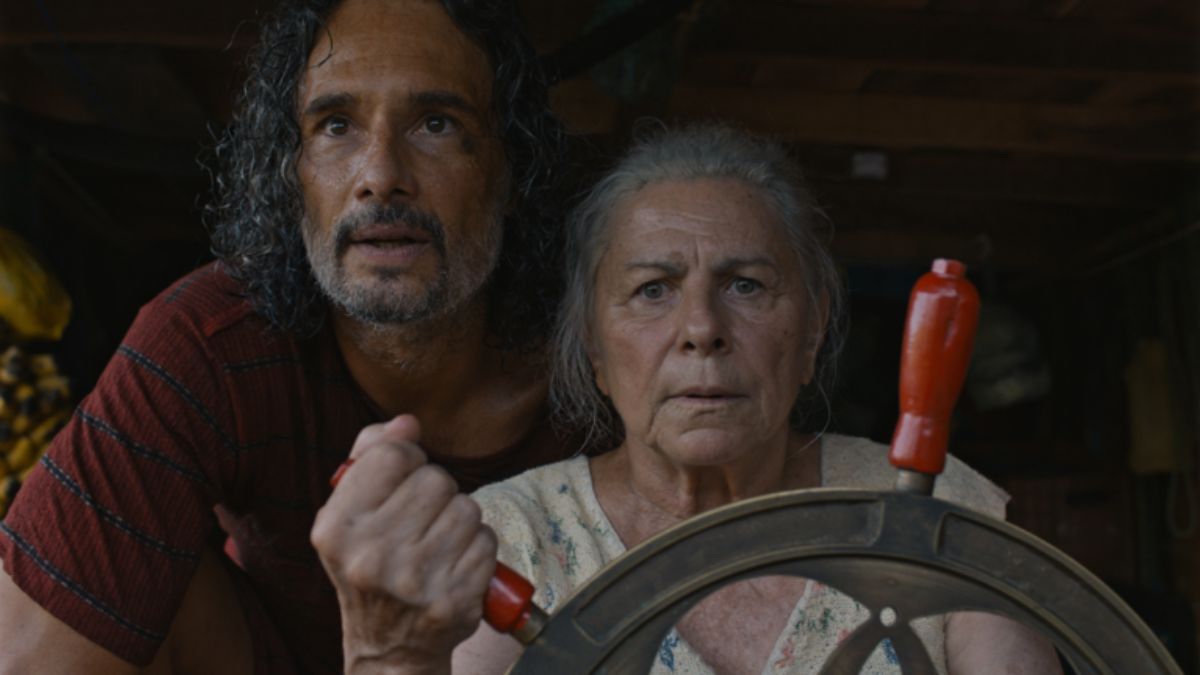
Hollywood rarely tells stories about anyone over the age of 40, and when they do it is almost always a movie star in a legacy sequel of some kind trying their best to appear to not have aged in the past 3 decades. And any other movie that does actually feature an older protagonist is almost always about regret, nostalgia or death, after all, how can one come-of-age when they are already “of age”? The Blue Trail is a surreal Brazilian drama that challenges this notion, starring Denise Weinberg as Tereza, a 77-year-old lady living in a world where the elderly are sent to a colony to live out the rest of their days through a “social isolation” program to better the economy. Tereza sets off on a boat down the Amazon river to avoid the heavy boot of the law, and finds herself on a journey of self-discovery and unlikely friends.
I was fortunate to talk to The Blue Trail’s director Gabriel Mascaro and learn about how after his grandfather passed away his grandmother took up painting despite no one in their family having a “creative streak”. He began to wonder why there were no movies about older people taking independence, which planted the seed for the movie in his mind. Brazil in The Blue Trail contains a mix of slightly futuristic technology and more surreal, almost magical, elements. The surrealism comes largely from the river itself and especially the blue snail whose secreted liquid can allegedly show you your future if it is dropped into your eye. As Tereza travels the river, she becomes close with a woman who sells bibles to locals, despite neither woman being religious. Religion plays an important role in the film, and the Amazon river is almost portrayed like a religious figure in itself, it grants freedom to those who need it and connects people through commonality

The Blue Trial, 2025. Directed by Gabriel Mascaro.
The Blue Trail is being described as an “essential boat movie” which is very apt, much of the films runtime is dedicated to scenes set on rickety barges. On filming on the water Gabriel said he practically had a fleet of boats, each boat covering a portion of the film’s production element, one for makeup, one for costuming and one for lighting. He said filming on water posed challenges, but that he enjoyed the process. Gabriel has extensive experience filming documentaries, and he said that that experience really helped him connect to the personal aspect of the story. It was important to him that Brazil was represented through the people, not just through the ecology like in William Friedkin’s Sorcerer or through violence like in Fernando Mereilles’ City of God. While those movies are incredible and have their space in cinema history, The Blue Trail carves its own identity within Brazilian culture in its focus on individuality and independence.
In a tight 87 minutes, The Blue Trail delivers a deeply personal and charmingly funny story. It was a privilege to be able to talk to Gabriel Mascaro, who seemed so connected to the film and was extremely entertaining to chat to. The Blue Trail is showing at Perth Festival now until the 21st of December.