


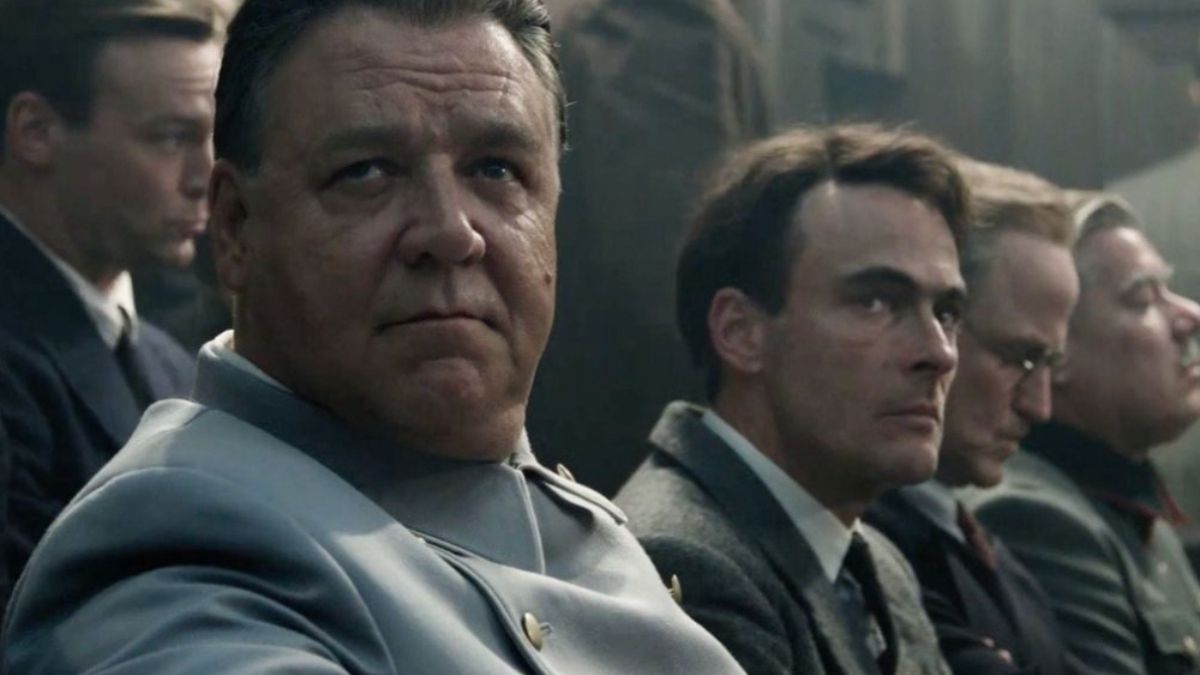
Set immediately after the end of World War II in Europe, ‘Nuremberg’ is not your average war movie. While the evidence of physical destruction lingers in the urban landscape, there are no battle scenes, bombing raids or explosions. Its focus is on the immediate aftermath of the allied victory: specifically the prosecution of Nazi war criminals.
Adolf Hitler’s second in command Reichsmarshall, Hermann Göring has survived and is about to be put on trial by the allies together with several other senior Nazis in the city of Nuremberg. As such this film is more about the causes and the immediate consequences of this horrendous war.
Although the focus is on Reichsmarshall, Hermann Göring (Russell Crowe), there are two main characters in this story with the other being his psychiatrist Douglas Kelley (Rami Malek). He is employed to evaluate the mental health of Göring, who – along with other senior Nazis in allied custody – have been selected for a war crimes trial. As such this film is a mix of biography, war history, psychological analysis and morality tale all set within the context of a grim reality.
Rami Malek plays the well-meaning doctor trying to get into the mind of an arrogant militarist while Russell Crowe excels in making himself physically and psychologically unattractive as a narcissistic psychopath. These two central characters are vividly brought to life by these talented actors in a cast of equally competent performers.
Dr Kelley seeks to fathom the psyche of men like Göring to understand their psychopathology and its legal ramifications. The intimacy of their exchanges in his claustrophobic cell contrast markedly with the scrutiny of his very public trial. Not surprisingly, this movie has the rather tense scenes of a court room drama. Göring oozes such a smug arrogance on the witness stand that we question until the very last minute whether he will actually succeed.

Nuremberg, 2025. Directed by James Vanderbilt.
Since it deals with actual events, this film has the added benefit of historic newsreels shown throughout which enhance its reality. For example, during the trial scenes, original courtroom footage is interspersed with the actual film scenes. The most confronting aspect are the newsreels shown as evidence at the official trial. One can only flinch at seeing those heaps of emaciated corpses piled on top of one another like heaps of garbage outside concentration and labour camps. Their gaunt faces stare blankly into oblivion.
This film not only reflects the the historical record, it provides a more personal glimpse into the period. The interpersonal exchange between prisoner and psychiatrist is a rare example of enforced intimacy between former enemies. This, in turn, enhances the historical record: the fate of Herman Göring is well-known but equally important is the fate and subsequent work of his psychiatrist – work which, at the time, was largely ignored.
Dr Kelley went on to warn society that the dangers of Nazism had not been defeated with the allied victory. He concluded that the evil he was analysing was not unique to Nazi Germany: under the right (or rather wrong) conditions, such inhumanity can easily emerge. Under certain circumstances racial, ethnic, religious hatred can be used to incite the murder of innocent people (Are there not more than a few examples of this inhumanity in our contemporary world even, more recently, in our own country?).
Inevitably, much of the film is grim and confronting. This most catastrophic war in human history did not take place in the distant past when our ancestors were in the grip of superstition flinging spears at each other. It occurred in the 1930s and 1940s in a supposedly civilised nation. The script, acting, editing, photography all combine to transport the viewer back to this period of our not-too-distant past.
‘Nuremberg’ is a graphic and realistic reminder of something we cannot afford to forget.