


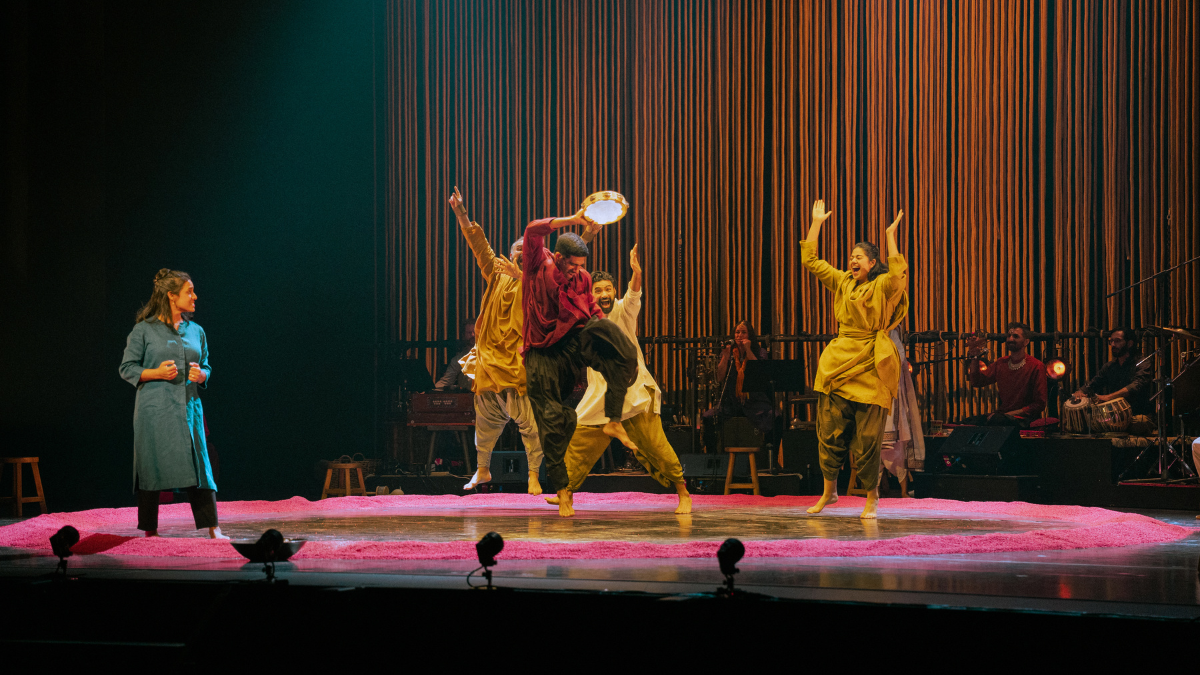
Encounter, in collaboration with Why Not Theatre, brings to life an ancient Sanskrit tale in a brilliant production that spans five hours and two shows, yet still leaves you wanting more. I can’t even tell you how many characters there were—as I recapped the story after each act with someone who grew up with these stories, I realised I had lost count. There are two types of people who end up at this show: those who know the story well and excitedly follow the flow, and people like me, hearing it for the first time, eagerly waiting to see how the vows will be fulfilled and wondering how many decades the story has to progress before “the bit.”
The show has it all—war, revenge, vows, grief, honour, and a philosophical undercurrent. It’s like a desi version of The Avengers—if The Avengers was actually good. With an enchanting narrator who provides a steady presence amidst this extravagant story full of emotional highs and lows, they exist as both an outsider and a character. In a tale filled with gods, the narrator is somehow looking over the characters while also being part of their world.

Mahabharata. Photography by Apurva Gupta.
This ancient tale is a Hindi creation story, among other things. It holds so much duality in different ways. It is collectivist in its familial bonds and loyalty, yet individualistic in the way each character’s strengths are illustrated. It frames the concept of right and wrong as anything but a simple ethical dichotomy. Despite the themes of war and honour, it has no clear protagonists or antagonists—no one is better than anyone else. In a world where everything is happening everywhere all at once and life is cyclical, how can you pinpoint a moment in time and simply reduce it to one of two options?
The first part began with a six-piece band soundtracking the events with a Sanskrit chorus, bringing an air of tradition and ritual to it all. Behind the band, there was no backdrop, leaving the equipment that usually sits at the back of the stage exposed for all to see. The set design gradually took shape piece by piece as the story unravelled throughout the first act. There was a moment towards the end of the first act when I realised I hadn’t even noticed the set coming together right before my eyes—such was the enchantment of the story unfolding on that very same stage.
The second and final act of Part 1 ended on a cliffhanger, making the days between my viewings of Part 1 and Part 2 stretch on forever, leaving me desperate to find out how two particular story arcs would unfold. The joy of such an expansive story is that different characters will pull different people in—perhaps other patrons were waiting for different arcs to drop.

Mahabharata. Photography by Apurva Gupta.
When the time finally came to see Part 2, what felt like a lifetime later (albeit only a few days), it opened with an elaborate set. Featuring ambitious visual graphics, including live-streamed close-ups of particular actors’ faces while they were on stage, it was an unusual technique I hadn’t encountered in theatre before. I appreciate artists pushing boundaries and experimenting with ways to incorporate technology into such a physical art form.
The set design in Part 2, much like in Part 1, changed throughout without me fully registering it. Except this time, it started with many elements, then gradually stripped away to reveal the bare bones of the stage once more. It speaks volumes about Lorenzo Savoini’s set design that it blended so seamlessly into the story without drawing conscious attention. In one of the final scenes, as the technical gear became visible at the edges of the stage, Krishna—one of the gods—delivered a clever theatrical quip. As the narrator asked why he stepped out of the scene of human actors, Krishna turned to the audience and said, “We are born, and then we die,” before flashing a quick smile in the direction of the actors on stage and adding, “And in between, we act.”
And that Shakespearean reference is possibly the greatest philosophical implication of the entire show. As you realise that the universe began on this stage in Part 1 and spanned through various lifetimes until the end of Part 2, the set design mirrored the cyclical nature of existence. When all is said and done and the set fades away, all you are left with is the stage—a rather clever implication that all the world’s a stage. And somehow, amidst all the philosophical conundrums, this simple and elegant theatrical metaphor tickled me the most.
And now, I am left with a well of philosophical ponderings to carry with me throughout my life, realising that I may never again witness something so extraordinary unfold on stage.