


This review should come with a disclaimer that it was written by an Australian, so readers can’t preclude tall poppy syndrome. Make of that what you will.
ALL BOYS is a highly charged play that has been generating a lot of buzz. The day after I attended the show, I was listening to RTRFM when playwright Xavier Hazard gave insight into the creative process in an interview. His experiences attending elite all-boys schools were mentioned as an inspiration in that conversation. I do wonder where someone’s creative direction can take their future projects if they’re drawing on their personal experience. This constitutes one example in a wider trend I’ve observed in the Perth theatre scene of a semi-autobiographical approach.

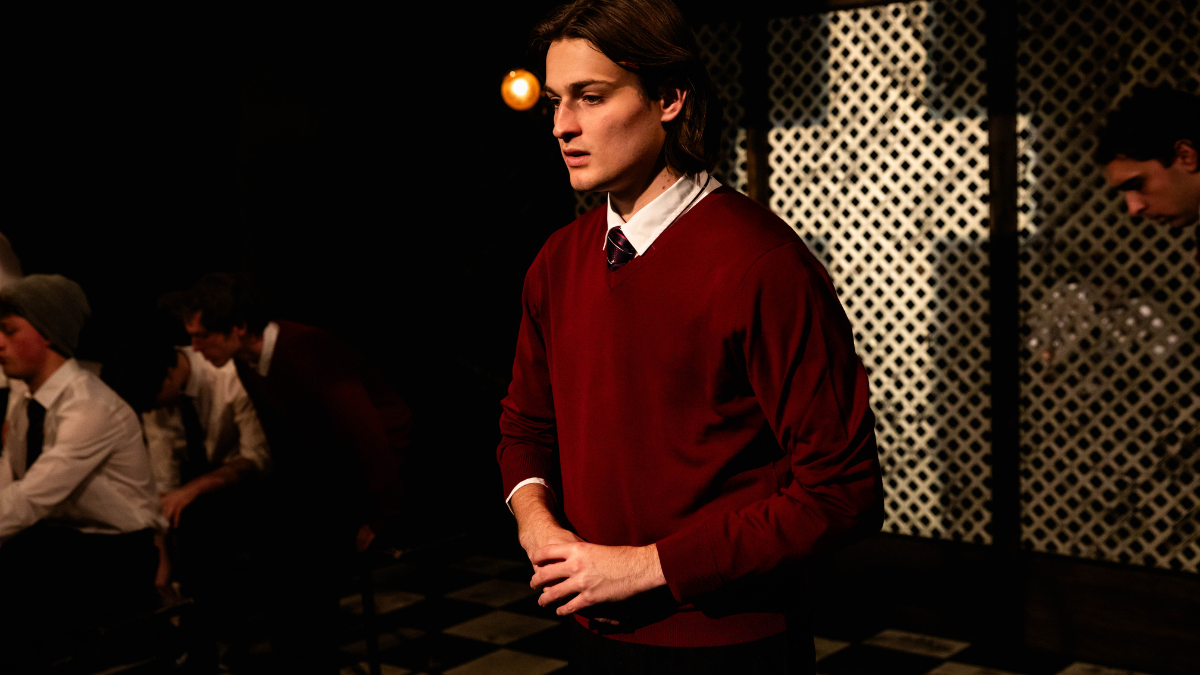
Cast of ALL BOYS. Photography by Sophie Minissale.
There’s a certain irony about someone who went to an elite Catholic boys’ school that brands itself as a launching pad for greatness, producing a guy who writes a play about that phenomenon, garnering the hype that ALL BOYS has. My first thought going into this show was an expectation of internalised, and possibly also external, homophobia among the themes. Check.
Despite a couple of ethnically diverse characters, and a sprinkle of gays, and other experiences of adversity the creatives involved may bring to this piece, the show vividly illustrates the monoculture of all-boys schools. The cishet white male voice was prominent in this one, which, unlike the institution it’s portraying, is somewhat novel in theatre. Conceived as a catalyst for dialogue, it gives outsiders insight into a secret world hidden in plain sight, and insiders a platform for a story that wants to be told.

Cast of ALL BOYS. Photography by Sophie Minissale.
The narrative follows 10 boys through high school around 2009-2014, which places it within the years-long inquiry by the Royal Commission into Institutional Responses to Child Sexual Abuse. There’s another dark theme on the program. With 10 actors crammed into The Studio in the Blue Room Theatre, their vignettes are intended to be a solution but don’t close with a clear understanding of what that solution is. The problems are clearly articulated, which leaves it up to the audience’s imagination to find a solution. With a nearly 2-hour runtime, this script would have been well-suited to a TV mini-series to give the viewers a breather and an opportunity to pause for introspection between episodes. Such a format might be more conducive to a resolution.
I don’t know if I can say that I felt like all 10-character arcs had a resolution. Or if the institution as a character had a resolution either. The lead-up to the final scene had the poster boy Jack V (played by Samuel Bennet) spreading the word of his intentions for something epic at the final Year 12 assembly. I expected this would be a resolution delivering some comeuppance to the institution that housed so much hurt for all the characters, some impertinence perhaps. Instead, the final scene delivered closure tangibly for just 2 gay characters who hold hands, while all 10 characters recite some school chant. With so many characters, the respective resolutions possibly took a considerable chunk of the show’s time to play out, leaving high expectations for the crescendo at the end, which didn’t sound out.

Cast of ALL BOYS. Photography by Sophie Minissale.
Had this been presented in a longer, more detailed format, the script’s substantial concept could have been more fully realised. However, the intention to present these boys as children who grow into humans who perpetuate or comply with horrible things without a tone of judgment fails to humanise them. With so many parallel stories, there wasn’t an opportunity to explore the depths of their experiences and what led the characters down their respective paths. It felt like a proverbial slap on the shoulder and a “you’ll be right” with an expectation to accept the status quo and get on with it. There were subtle hints of change with the coming out of gay characters and one character’s choice to end an era of hazing rituals. These character arcs demonstrate this story’s potential.
Maybe a play with an expansive cast of adolescent characters scrambling about the stage through their hyper-masculine high school experiences is a precise representation. It’s not my place to say if it was. I found it confronting to walk in and have my attention directed to a room full of men. Conversations at the bar afterward confirmed that at least one man in the audience that night didn’t feel as confronted as I did. It will be interesting to see how this will be perceived by other crowds, particularly as another production is set to debut in the play’s spiritual home in Sydney. Don’t take my word for it though; one audience member walked out in the middle of the show, proclaiming it as “morally corrupt.” Ooh, edgy.

Cast of ALL BOYS. Photography by Sophie Minissale.
There were funny moments that gave a fleeting deviance from seriousness. The offhand remarks gave this weird comedic vibe, which didn’t cut through the discomfort or intensity of the rest of it. The subtle digs at the tokenistic treatment of Aboriginal people and white saviourship landed well; straightforward and without satire. It’s really positioning itself as thematically serious.
One of my favourite things about theatre is the air. Much of the art we consume occurs with physical distance from the artists, either by design or by evolution. Theatre remains, for the most part, an immediate art form that brings creators and consumers into the same room. The audience goes in willing to have their attention held captive, with their presence not as dependent on loud gestures to retain their viewership, at least physically. The smallest details can be felt due to the ability for them to resonate through the shared air. There was so much ambition in this play, with an eagerness to tell the story that aggressively demands your attention. The intention to highlight the absurdity of sex-segregated schools was clear, but the overall tone of the play felt like a caricature that fell short of its aim of a humane resolution.
It’s hard to know who this play is written for. I can’t imagine the old boys would be comfortable with the accountability. Nor how women or people who had perceptions of their gender preclude their enrolment would relate. With an emerging trend of schools becoming mixed-sex, this production exists as a statement of a world that will eventually fade into history books. The excess of this play comes across as an ambitious attempt to fit as much into this story as possible. It would be nice to see more dialogue on the emotional experiences of men.
ALL BOYS presented by every other theatre company at The Blue Room Theatre from August 6-22.