


I don’t think I’ve ever felt at ease watching ballet. Though what’s happening on stage is often dubiously hetero-normative and borderline misogynistic, what really gets me is the social aspect—to contort your body into stiffly comfortable in the seat, to not sweat or sneeze or make noise or be queer…just assimilate, tell your body to stop, and give your entire attention completely to the stage. Thankfully, Patrick Gunasekera’s The Little Mermaid is the antithesis of this sentiment, and I am in love.
The Little Mermaid is a ballet adaptation of the Hans Christian Andersen tale, where the Little Mermaid is a queer, working-class, mobility-aid-user from the underwater suburb of Mandurah, who falls in love with a princely real estate agent from Claremont. The dramatic shifts in setting, gender and queerness shift the tale thematically, but the broad strokes of the story are the same. It uses adaptation to its benefit—the story is already so known thanks to the Disney adaptation, and it allows the meaning beneath the narrative to shine through more clearly, gleaming with dramatic irony.

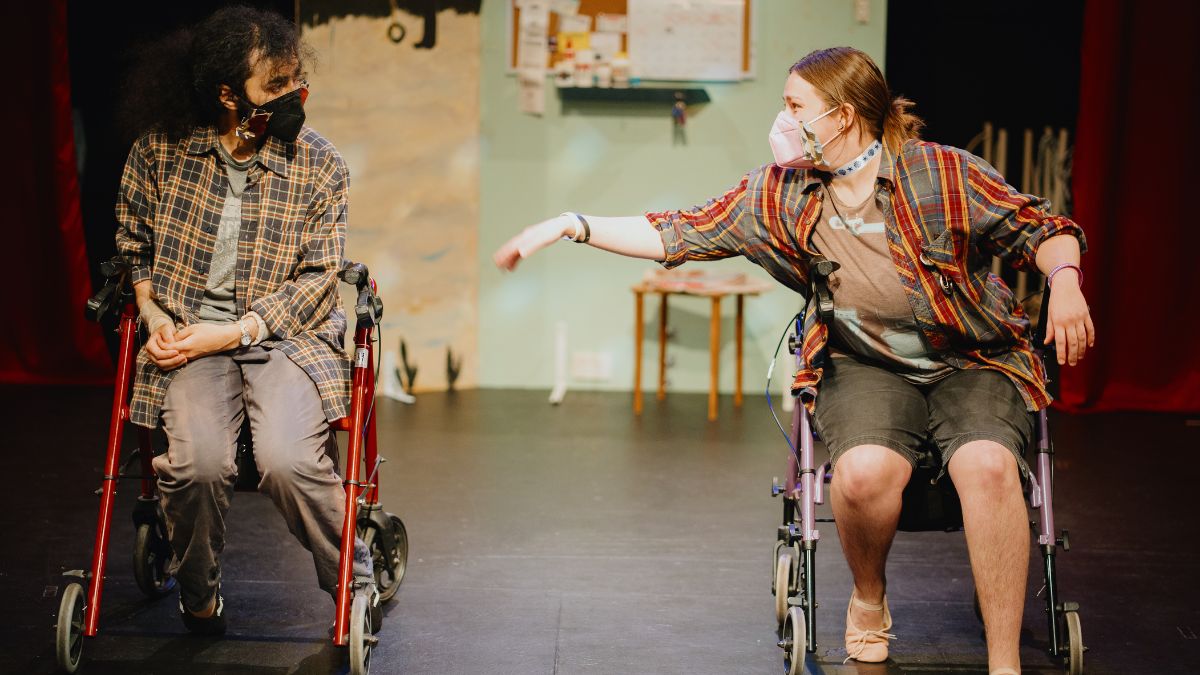
The Little Mermaid. Patrick Gunasekera, Ez O’Keefe and Rayna Lamb. Photo by Josh Wells Photography
All the performers were stunning. The actors were either queer, or disabled, or both, which branches off of Gunasekera’s invaluable activism over the past couple years in various local arts spaces, and it’s lovely to see the fruits of his hard work. I want to especially shout out Rayna Lamb: her acting and energy especially is incredible/close to magic,whether it be the cold, domineering matriarchal Sea Queen or the kinder, softer, store manager was pure magic. This is a lot of the actor’s first performance, and it’s clear that their lack of experience is purely a result of ableist casting because everyone on that stage is brimming with talent, and I hope their performance in this show opens up future opportunities for all involved.
Patrick Gunasekara’s performance as the Little Mermaid deserves to be singled out as well. He has a prolific history with dance, and this translates directly into the wealth of nuance in his performance. Patrick has a certain way of redirecting disability towards artistic possibilities; there’s a certain awareness of the body that others without a chronic pain can’t access. That hurt, that awareness of every bodily movement and the effort needed to move it, that desire to be efficient and not waste resources to something superfluous, for every movement to mean something, really translates well into the narratives of otherness and fitting in, whether that be hiding your queerness in hetero-normative spaces, or hiding your dwindling financial status amongst the wealthy and lavish.

The Little Mermaid. Bella Scullard, Alison Evans and Octavia Hall. Photo by Josh Wells Photography.
The production of this show strikes that lovingly-crafted DIY aesthetic, without diminishing quality. Shows like this take a village, and I feel like I could feel the presence of everyone who crafted a part of this massive project. Yes, you can see the brush strokes on the set dressing and car horns in the recordings, but you can also see and hear the people who worked on this show, and it made everything feel much more special and lovingly-crafted by human hands (especially in today’s day and age). I feel like one of the few flaws of the show was in the clarity of how ‘being underwater’ and ‘on a yacht’ were communicated, but (1) after it was first established it was easy to pick up, and (2) any ‘flaw’ I feel I saw in the show was, like so much of the narrative, the fault of greater forces beyond anyone working at the Blue Room.
This show has an unwavering support of the audience and their safety that I deeply admire. For example, while it’s normal for shows and productions nowadays to come with trigger warnings, this show’s is both incredibly comprehensive and includes a full plot synopsis plastered to the side of the wall if you want to know exactly when the triggering bit comes up. I think some shows are precious with their material and don’t want to ruin the surprise, but I think The Little Mermaid’s approach—to be precious with their audience, not in a demeaning way, but rather loving and considerate manner—feels more right. There are many other considerations taken, too many to name succinctly, but I’ll only briefly mention that I really enjoyed that it wasn’t a lockout like so many productions are. I don’t think anyone used it in my showing, but it helps alleviate a certain claustrophobia within the theatre.

The Little Mermaid. Patrick Gunasekera. Photo by Josh Wells Photography
One point that really interests me is that every performer is wearing ballet flats. This show is so against the state of ballet we found ourselves in that it genuinely shocked me—this low-cost, inclusive show still holds the primary signifier of an artform with a…tumultuous image, cost, and ethics. I think it is ultimately Gunasekera showing his love and respect for the art of ballet, with all of its funny eccentricities, whilst rebelling against is the conceit that ballet is only for rich, ‘normal’ people, and that poor, queer, and disabled people can barely enjoy sitting in the theatre, yet alone being on stage. What’s more interesting is that it’s also attacking the other side: as I’ve made it quite clear, I don’t participate in ballet, because I’ve felt so othered and rejected by the rich ‘normal’ assholes that litter its community, and The Little Mermaid is here to remind me that, though some traditions are awful, the art and the people and the dedication to said art is beautiful and should be appreciated.
The Little Mermaid is amazing—and I’ve barely touched what this show has to offer. It’s funny, it’s sentimental, it’s so grounded for such a fantastical tale, there’s so much going on that it’s worth seeing twice, and it’s a shame I’m writing this so late for the in-person performances (only Thursday 20 and Saturday 22 left!), though it is followed by two-weeks of livestreamed performances, which I’m sure will bring a new magic to the production. Regardless, I hope the future of this show grows beyond its original run, because I don’t think I’ve seen something so simultaneously important and entertaining. It’s a tale of a queer boy with dreams of a fairytale ending in a world that does not accept him, and it hits like you would expect. This show walks the tight rope between empathy, education, and entertainment, jumps off, does 500 backflips and lands into a bucket full of your tears. Representation is important, not just so that people underrepresented in the White Sea of popular culture feel accepted in our world, but so that people like Patrick Gunasekera and the cast of The Little Mermaid can keep making beautiful art to cry at.