


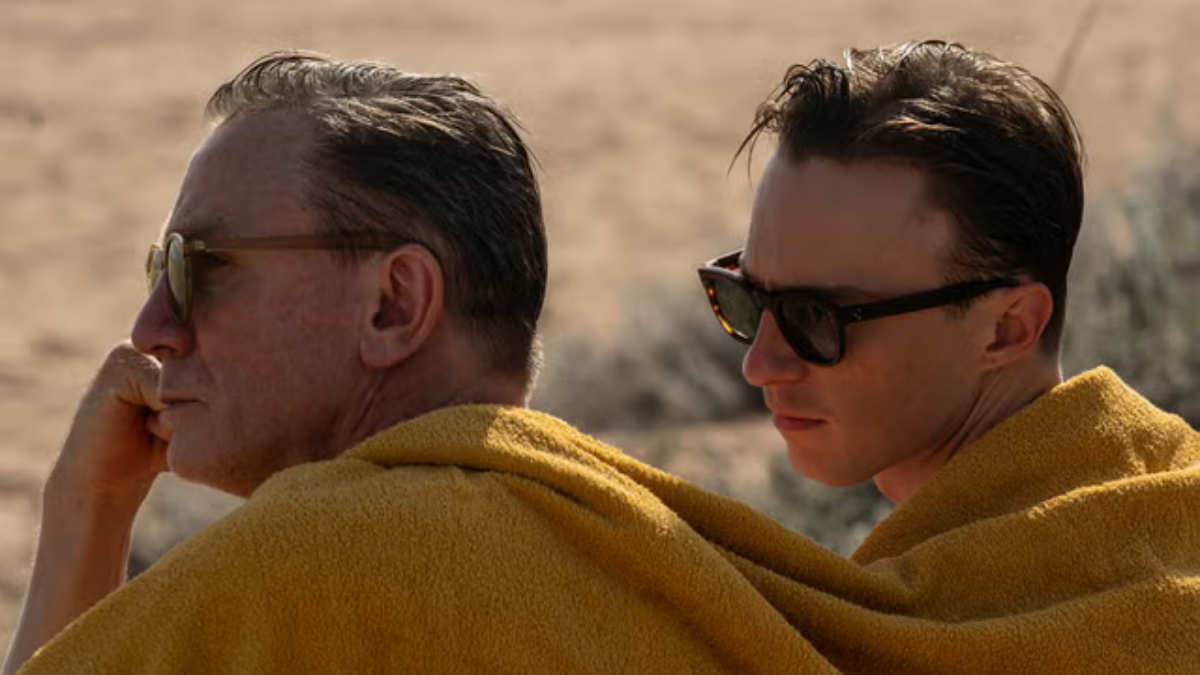
In his latest film, ‘Queer’ Daniel Craig shows yet again what a talented and versatile actor he is. In this movie he could not play a character further removed from his past roles, especially that of his glamorous, lady-killer James Bond. There is definitely nothing glamorous about his latest screen character.
Based on the William Burroughs novel of the same name, Craig plays William Lee a washed up, ageing, drunk leading a meaningless life in 1950’s Mexico. He resides there as his addiction to opiates would make him a criminal in his native US. He is a drifter living in cheap hotels. Clearly, he has a regular income but we never really know its source.
He lives in a seedy part of town inhabiting the cheap bars where he socialises with fellow US expats and picks up the occasional male prostitute. He spends his days moving from bar to bar and secluded gay clubs in the vicinity.
One day he meets a much younger, attractive man Eugene Allerton (Drew Starkey) who seems too good to be true and they form a relationship. After numerous meetings (including very realistic sex scenes), he joins Lee on a trip to the Ecuadorian jungle in pursuit of some exotic plant that supposedly induces telepathic experiences.
Burroughs frequently indulged in opiates of all sorts and tried to convey these experiences in his writing. Occasionally this could lead to a rather fragmented, episodic writing style that might be, at times, difficult for the average reader. However, this film incorporates all these quirky elements into a coherent story which is easy to follow.

Queer, 2025. Directed by Luca Guadagnino.
Since the main characters indulge in opiates, the effects of these substances are imaginatively portrayed, especially towards the latter part of the film. These sequences are graphic and, at times, rather unsettling. However, we can easily tell what is reality and the effect of psychedelic drugs.
Even though it deals with tawdry aspects of life in seedy places, the film is not overwhelmingly oppressive, owing to the visual elements. The photography has a clarity which illuminates even dingy rooms and clubs and the scenery is impressive – the jungle scenes were actually shot in Ecuador with Sicily and Rome doubling for Mexico.
The cinematography enhances the solid performances. The final scenes where Craig is at his most physically unattractive and miserable are skilfully edited. The imagery and symbols create an effective and atmospheric finale without any dialogue.
Despite, the themes of decadence, escapism and hopelessness (mostly of Craig’s character), it is not a bleak piece of cinema. The film blurs the line between escapist fantasy and grim reality and implies that neither is always what we expect it to be.
The impressive cinematography and realistic performances lift the tone beyond the level of anguish and despair. We leave the cinema feeling empathy for the main character – an individual we feel we know – and his situation portrayed so convincingly.