


The Composition Project is a fantastic initiative – young composers rarely get an opportunity to have their music performed, yet alone by someone other than themselves. As I look through the WASO program, year after year it’s just dead people and John Williams, so any WASO performance that showcases the future of music, I’ll try to be there.
The performance was an hour centred on four young folks: Darcy Lewis, Lucas Tomkins, Somayeh Heidarvand, and Domenic Lamattina. Each presented one piece for a condensed, 14 piece orchestra, conducted by James Ledger, who both directed this project and the composition degree at UWA.
Ledger’s joy and passion for these young composers is infectious, and is displayed most prominently in his pre-show, on-stage interviews with each composer before their piece was played. These were charming; it really humanised the composers, which is nice to see in comparison to the deeply serious perception of the capital-C “Composer” throughout history.
Darcy Lewis was up first, with the experimental and grounded Aluminated Grey. The piece was meant to invoke that not-blackness you see when you close your eyes – the blips and bloops of light intermittently flashing between the shades of darkness. As the piece develops, the colours and intensity grow, blinding your metaphorical eyes to the brink of over-stimulation, like exiting the tunnel on Graham Farmer Freeway.

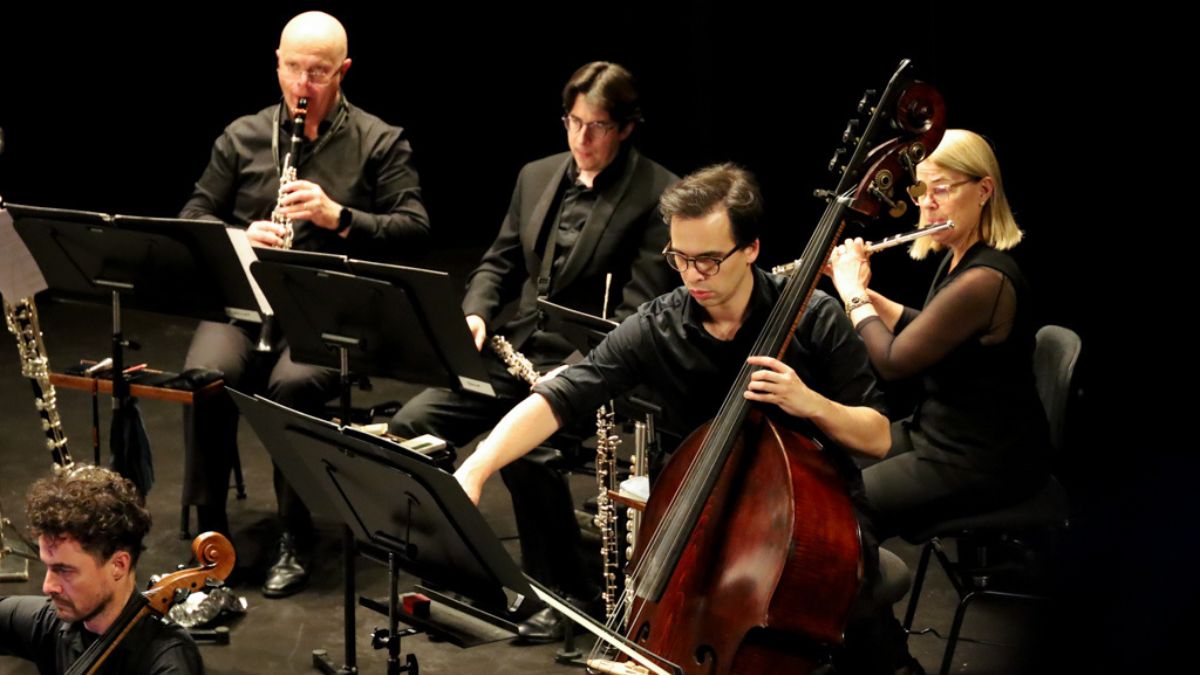
WASO’s 2025 Composition Project. West Australian Symphony Orchestra.
“Illuminated” spelt wrong on purpose – it’s a cheeky pun to highlight the use of aluminium foil on the bass clarinet, which created this rattle-like hiss that created a foundation for the rest of the piece, like the grey floor in which all the eye floaters dance. Lewis has a fantastic spatial awareness that he magically embeds in his compositions; you’re not just listening to music, you’re watching music, you’re sharing space with the music, and in turn the music feels aware of you and your presence. It’s this, and his ability to play into the tropes of classical music (whatever classical music is these days), that I think earned him the WASO scholarship for 2026 (spoilers!).
Lucas Tomkins was up next, with the grandiose and romantic Infinities. The title triggers my 2014 Tumblr brainrot, namely the John Green quote “some infinities are bigger than others”, but moving past the teens-with-cancer connotations, I feel Tomkins’ piece evokes the various infinites of nature quite well, specifically at Fitzgerald River National Park (where this piece was conceptualised). How long will the rocks on the shore stick around? How long will the grass cover the sandy dunes? How long will the tide ebb and flow? Obviously it’s not infinite in the technical sense, but it’s as close as we can get, and how lucky are we to be able to even perceive a small section of infinity?
The music behind this idea is fittingly beautiful; it reminds me of Holst’s The Planets at times at just how well the arrangement flows. A particular feature I really enjoyed was this repeated blending from section to section – an instrument will hold out a note for it to be continued by another, fading seamlessly between the two. Unfortunately, the piece was too beautiful: it’s all resolution with no tension, and ends up at times bland, edgeless, and vanilla. This isn’t an indictment of Tomkins; his way with harmony and orchestration is fantastic, especially for a 19 year old. All I will say is that when he discovers that ugly sounds are cool and fun, it’s over for y’all.
Somayeh Heidarvand’s Resonances from Matilda Bay was by far the most innovative and conceptually interesting piece of the bunch. Similar to Tomkins’ work, Resonances is focused on evoking a location, but unlike the previous piece (and unlike most orchestral pieces based on places ever), Heidarvand attempts to mimic the literal soundscape – like a still life painting of sound – instead of the conceptual feeling and emotions of the location. The end result is quite magical – you can hear the birds, the waves, the swans, and the wind, all weaving between each other with believable naturalism. The birds particularly had stood out to many audience members – it was mentioned by everyone I talked to post-show, at least.

WASO’s 2025 Composition Project. West Australian Symphony Orchestra.
An interesting point that this piece sparked in me was just how much an orchestra clashes with literalism. Instruments are built for the conceptual and the abstract, and yet Heidarvand is almost forcing these instruments into the real, becoming almost hyperreal in the process. Natural sounds are elevated and emphasised greatly once placed in the hands of an orchestra; where it once was subtle is now blasted through metal tubes of these reverberant instruments into the ears of the audience. I really enjoyed this strange struggle for realism in a conceptual medium, and Heidarvand’s understanding of focus amongst an ensemble was fantastic.
Finally came Domenic Lamattina, with the fourth-wall-breaking, programmatic I Jest, You Jest. The story of the piece is that a jester gains magical power and starts wreaking havoc around for the simple sake of chaos – eventually the jester realises that they are both in a piece of music, and can manipulate the instruments themselves. It is reminiscent of the soundtrack behind some classic Looney Tunes shorts, as pointed out by Ledger in their interview, I would say especially in the technical writing, the frantic movement, and pure evocative imagery.
The fourth-wall breaking was a good way to solidify the piece in the modern day, with the percussionist rock-beating a dinky orchestral drum kit, the french horn wildly going out of time in an uncontrolled brazenness, and the flautist straight up singing her part at one point. The big achievement of I Jest, You Jest is making a comedy-centric orchestral work that’s actually funny, enough to cause a classical audience to laugh. It is extraordinarily hard to do, and Lamattina delivers in spades.
Final thoughts: the Composition Project 2025 was a tremendous success; I feel invigorated and excited to see what these four composers do next, and I’m sure a fair amount of the sold-out audience feel the same. The one part of overall criticism, to no fault of the composers, is that it was disappointing to see a lineup of three white dudes with the token woman/person of colour wrapped into a single composer, especially in 2025. Though, with WASO’s track record of almost exclusively dead/old white guys, just seeing some youth in the curation is hopeful, and hopefully these composers get their works played at WASO again before they hit the grave.