


On Saturday I had a busy day: I started work at 7:30am at one job, then met a friend for lunch in the city, then I saw a show at the State Theatre Centre, left to go to my evening shift at a different job, and then returned to that show to finish up at midnight. Normally I would not bore you with details of my schedule, but the show I saw suggested to me that these details are not so boring after all.
12 Last Songs is a part-live exhibition, part-performance, conceived by a Manchester-based theatre company called QUARANTINE. Their twelve-hour show (I know, I balked at that too!) was on for one day only as part of this year’s Perth Festival.
From 12 o’clock midday to midnight, 32 workers from around Perth set up on the stage of Heath Ledger Theatre for a paid shift. When I first arrived around 3pm (you could drop in and out at any time, thank goodness) there were about six stations with people set up for their shift, and Sisonke Msiamang, Perth’s own star moderator, was interviewing them as they worked.
The questions Sisonke was asking were some of 600 that had been pre-selected, and were being projected onto a temporary wall which was being wallpapered by local plasterer, Dan. Behind the questions were alternating videos of each station, which had their own camera trained on them, as well as intermittent clips of Perth from one of the producers who was on a day trip and sending back live footage of Perth Zoo, the Boola Bardip Museum, Fremantle, and the freeway between them.
While I was there the stations included a dog groomer and the schnauzer she was clipping, a hairdresser putting braids in a client, a florist, a woman gift wrapping miniature cars (think vintage Hot Wheels) for sale, and a painter and nude model. At any moment any one of these people were called upon to answer the question on screen, or to chat with Sisonke about their life and work. The questions included things like:
Were you well-behaved as a child?
What was the last thing you gave away?
If you had more free time what would you use it for?
Some of you I am sure are intrigued by this, and I am equally sure some of you are rolling your eyes. I, too, was unsure of what I would encounter with such an unusual format, but I was pleasantly surprised by how fascinated I was by the small details of these peoples’ lives.
One worker told us of her rebellious childhood and teenage years as a punk, while another explained that she grew up in a religious family and therefore married young and had children in her early twenties. It was pleasing to hear that no one expressed regret over their life’s path so far, despite how different they all were, and most were excited for the prospect of the future if they were not yet satisfied with where they had got to.

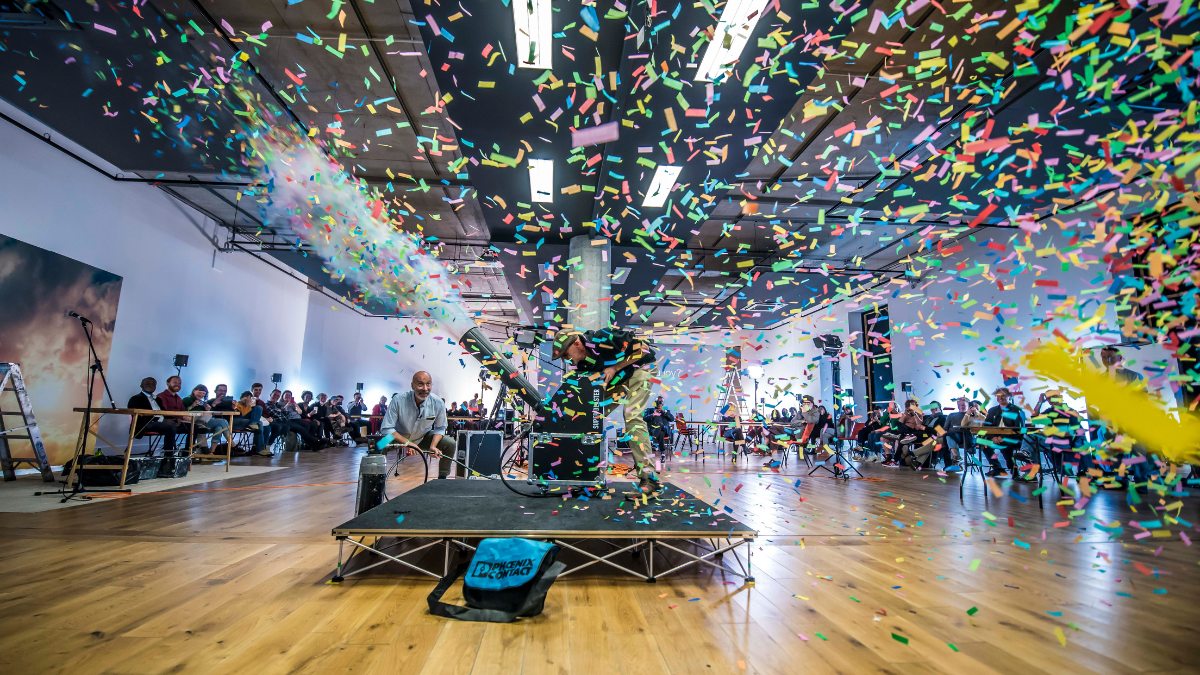
12 Last songs. Photography by Juliette Rowland.
It was difficult not to think about how I would answer each question if given the chance, and therefore interesting to see how much I had in common with this wide array of people. When Robert the cardiothoracic surgeon sat down for his interview (not performing his work on the stage, presumably open-heart surgery was a logistical challenge too far) I was oddly gripped by the humdrum of his daily life, and began to see the person behind the prestigious title.
I experienced a fascinating moment of connection when one worker answered the question what was the last thing you replaced? with “the head of my electric toothbrush this morning. Sensitive oral-B, because I am a receding gum girlie.” Obviously her phrasing got a laugh but I was stopped in my tracks for another reason: I have receding gums, should I be using a special toothbrush? I’ve never asked anyone else about it before, but it sounds like I am not the only one. Art finds ways to connect people that cannot be predicted.
The intimacy of these interviews was increased by being sat on the stage itself, free to walk in and out as we pleased. The usual auditorium seats were available to sit in but a large scrim blocked most of the view so it was worth venturing onto the stage and finding an available fold-out chair. Sitting in the auditorium also made hearing the workers quite difficult, as the microphones were often delayed when the interviewer moved between them, so the first part of their question was cut off unless you were close enough to hear. This would make it difficult to satisfy a larger audience than the 80-odd chairs on the stage allowed, but luckily when I arrived there were almost always a few seats free, even if it was hard to tell from behind the scrim. Logistically the show would probably work better in a warehouse space that allows for more visibility from all angles, but symbolically having ordinary people doing their jobs on a stage as beautiful as the Heather Ledger Theatre was an opportunity not to be missed.
On my train journey home after midnight, I found myself paying more attention to my fellow passengers. Were those drunk girls heading home or kicking on to their next party? Did any of them have plans tomorrow morning? How did they know each other? Did the young man playing rap music from a portable speaker enjoy the music, or did he like making noise? Was he a rapper? Had he ever wanted to be? Had the woman in the Hungry Jacks uniform had a good shift? Did working late suit her schedule, was she studying as well?
12 Last Songs was chaotic and weird and fascinating, and a reminder that everyone carries a plethora of stories within them, many of which could be worthy of an audience.