


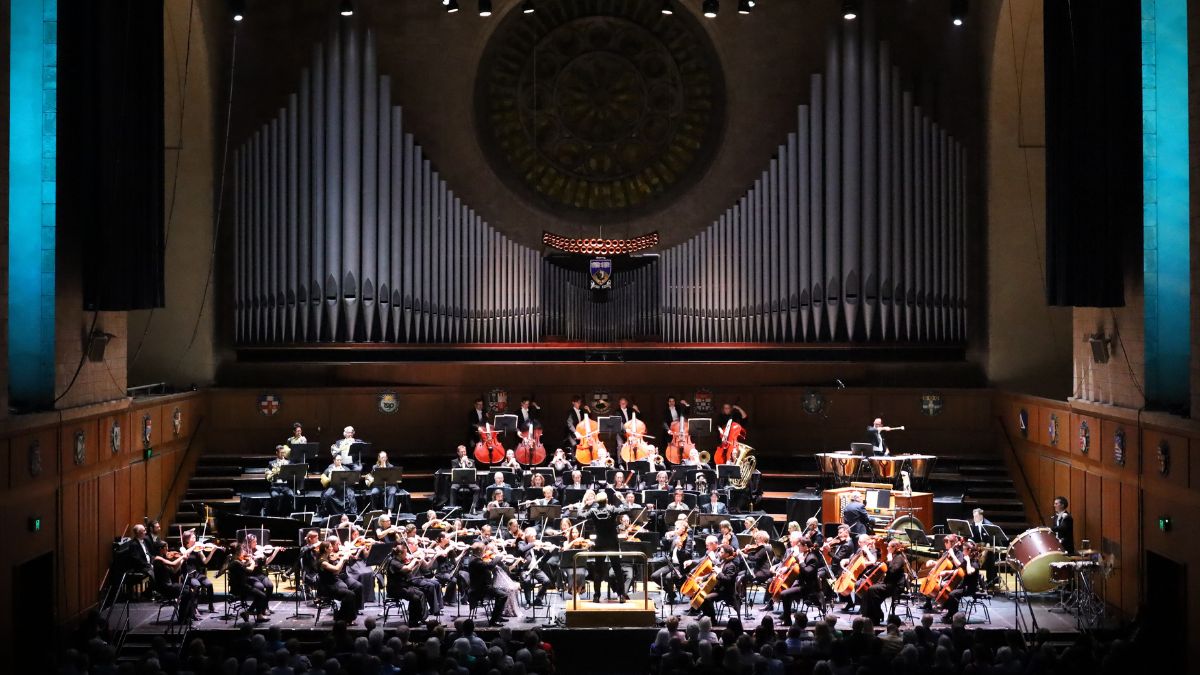
It was a night to savour by the West Australian Symphony Orchestra in the grand surroundings of Winthrop Hall for a program concerned, in three very different ways, with colour and scale. In particular, it was celebration of the unique, rarely heard sounds of the classical accordion and organ symphonics – and what a spectacular treat it was.
Conducted by Benjamin Northey, the concert placed two established favourites around a striking contemporary work: Aaron Copland’s Appalachian Spring Suite, Holly Harrison’s InsideOut for amplified classical accordion and orchestra, and Camille Saint-Saëns’ Symphony No. 3, the Organ Symphony. The contrasts made the evening feel varied without being disconnected.
The night’s most interesting and enjoyable voice was Australian composer Holly Harrison’s InsideOut: Concerto for Amplified Classical Accordion and Orchestra, performed by James Crabb. Its three unusually physical movement titles, “Stretch”, “Squeeze” and “Engine Room” were each a treat to behold. ‘Stretch’, in particular, was unforgettable in its pace and sophistication.
Harrison described the piece as pairing the classical accordion, which contains the sounds of the orchestra within its own machinery, with those sounds en masse in the orchestra. Rather than treating the accordion simply as a solo instrument singing above an orchestral accompaniment, InsideOut explores its physical qualities: expansion and contraction, air and pressure, agitation and mechanical motion. Paired with Harrison’s funk, rock and pop influences, it was a delight.

WASO’s Organ Symphony. Credit: Supplied.
Closing your eyes, it was difficult to discern was what accordion and what was flute, violin or contra bassoon – which was entirely Harrison’s vision. Crabb’s expertise on the instrument was also undeniable, and his passion and emotion was enumerated through his face and body as he expertly maneuverer almost impossible sequences.
My own criticism is that the piece is not (yet!?) available to listen at home – otherwise I’m sure there are plenty more discoveries awaiting us in its composition.
Copland’s Appalachian Spring provided a gentle and spacious beginning to the evening. The work has a lightness that remains audible even in its orchestral form. Under Northey, the music’s quiet opening had a welcome sense of stillness. Rather than trying to make every passage overtly dramatic, the orchestra allowed Copland’s distinctive open harmonies and clear instrumental colours to do much of the expressive work. As the music became more animated, the crisp rhythms suggested the bustle and pace that segued perfectly to the main focus of the evening in InsideOut.
What made this effective was the contrast between the simplicity of the melody and the sophistication surrounding it. The performance moved convincingly from celebration back towards calm, leaving the final passages poised and reflective rather than overly sentimental. And, as always, there is something entirely intoxicating in the sight of bows moving in unison as the volume and pace of the music builds. Magical.

WASO’s Organ Symphony. Credit: Supplied.
After interval came Saint-Saëns’ Organ Symphony. The orchestra handled the long journey towards the famous organ entrance with quiet restraint, almost matching the Appalachian Spring. The quieter writing mattered because it gave the eventual arrival of the organ the focus it deserved. While the organ is perhaps most commonly associated with church cathedrals abd vampiric doom (to those of us who are uninitiated, myself included) Saint-Saëns shows that the instrument can add luminosity and depth rather than simply doom. The contrast with the restless, staccato music that follows made the finale still more compelling.
When the organ finally asserted itself in the Maestoso, organist Stewart Smith’s prowess was clear and the effect in Winthrop Hall was thrilling. Yet the real achievement was that the conclusion did not depend on sheer loudness. Brass, strings, percussion, piano and organ accumulated into a broad crescendo giving Northey and WASO a suitably spectacular finish. A welcome departure from the mellowed organ recitals of the graduation ceremonies at UWA any alumni is familiar with.
Copland offered openness and tenderness, Harrison curiosity and eccentric energy, Saint-Saëns supplied grandeur. This was not simply an evening waiting for a famous organ chord, but a concert showing three very different ways that an orchestra can breathe, expand and fill a space.