


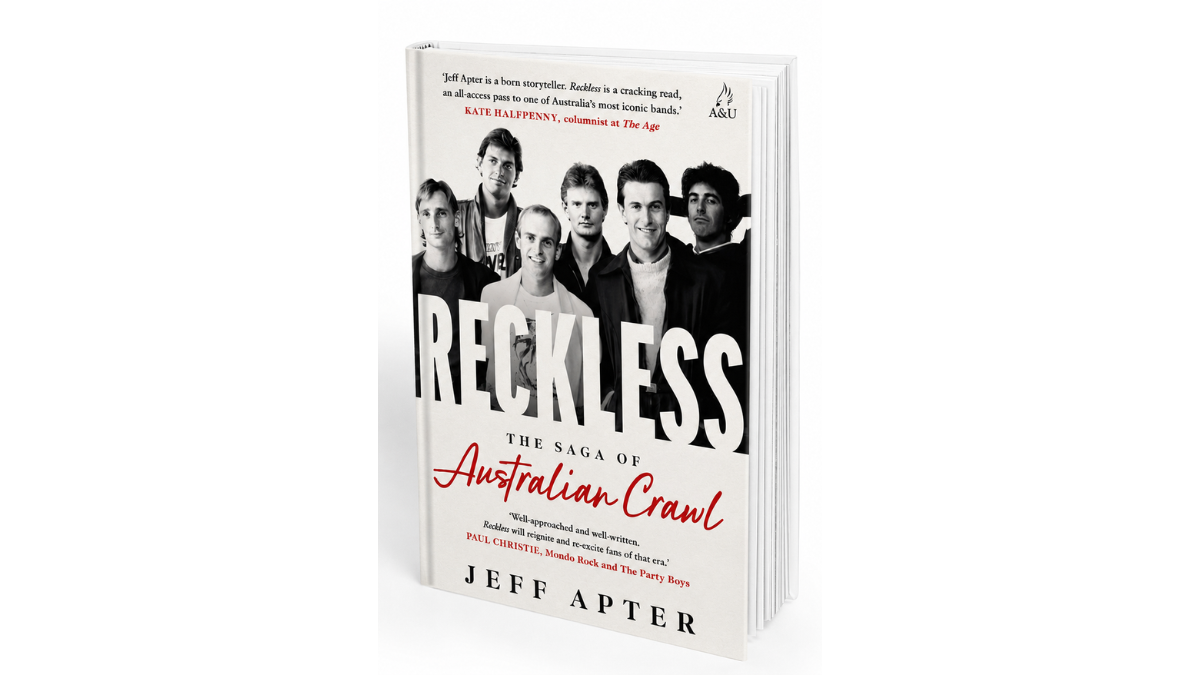
When the ABC’s popular music show ‘Countdown’ aired more than 50 yeas ago, it gave local Aussie groups (like INXS, Cold Chisel, AC/DC) an instant national audience beyond their state capitals and even a chance at international fame. Among the groups to benefit was Australian Crawl.
Theirs was a unique sound and presence. Although from similar backgrounds, they were different from their more ‘loud and proud’ contemporaries (Cold Chisel, Rose Tattoo, AC/DC). While they also came from working class backgrounds, most band members grew up in the more affluent area of the Mornington Peninsular and had a private school education. In fact, they acquired something of an upstart status among their peers due to their: ‘relatively comfortable backgrounds, good looks and sharp wits’ (p 194).
This book covers all the significant stages of the group’s history: from its formation to its national success to the band’s eventual demise and the subsequent fates of its respective members including one tragic, untimely death.
Not all former band members – specifically lead singer James Reyne – agreed to contribute to this group biography which perhaps leaves a few gaps in the record. Despite this, the author uses other sources such as previous interviews and articles to produce a coherent record.
There are many behind-the-scenes glimpses of the group dynamics – of the conflicts and the cooperation among the band members. Like any other group where members are forced by frequent gigs and long tours to spend extended periods within each other’s company, there emerged all sorts of intimacy and conflicts – some which were momentary and some which persisted for decades.

‘Reckless: the Saga of Australian Crawl’ by Jeff Apter, Allen & Unwin, Crows Nest, Sydney, 2026.
Among other things, the author reveals an in-depth analysis of the lyrics of their more famous hits. This analysis shows that their songs were not just ‘good-time-vibes’ but often had a veiled social critique even mockery of the standards and rituals they had to go through.
For example, one of their hits (The Boys Light Up) mocks their high school days when they had to attend weekly dance classes with the girls from a nearby school. The guys would have a puff (tobacco not marijuana) before going in to alleviate the boredom. The same song also touches on marital infidelity, secret affairs and other forms of hypocrisy and ‘new wealth’ materialism. Instead of being ‘loud and proud’ critics of society, they were more subtle in their social critique of the establishment’s ‘rules and regulations’.
Even the articulation of their lyrics became an aspect of this mockery: lead singer James Reyne would often deliberately slur certain words as part of his delivery. This became a trademark of his performances implying a slight dig at convention. (Clearly, private school dudes don’t always have to ‘enunciate’ correctly!).
Beyond all these basic facts, this work answers significant questions about this once popular group. For example, it explains why they never achieved significant success overseas and why the band had a such a comparatively short life cycle. More generally, it explores how closely their respective public personas resembled their individual personalities.
As with any pop group, there is usual mix of ‘drugs, sex and rock ’n roll’ but the emphasis is on the latter and the individual relationships among band members, their managers, promoters, partners and some of their peers as well as their audience.
The members of Australian Crawl were ordinary guys who, for a brief period, led extraordinary lives creating some very original songs, a few of which have become classics of Aussie music.