


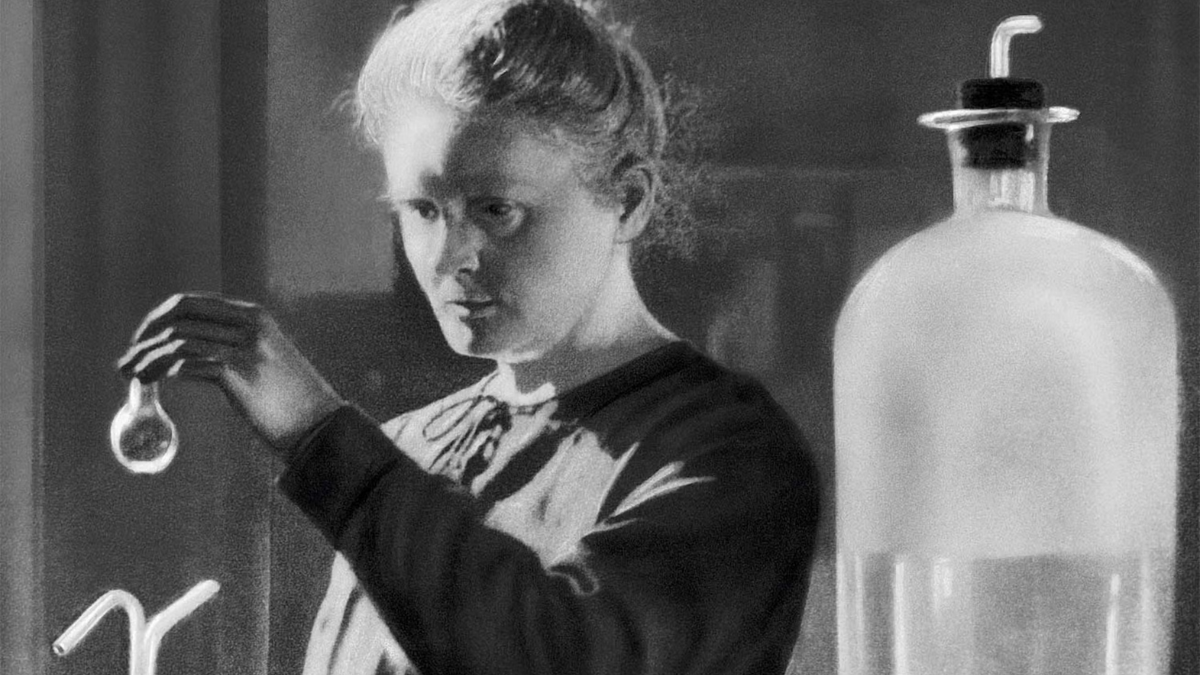
In this nuclear age we are well aware of the dangers and the benefits of radioactivity. This branch of physics has become an important part of modern science with applications ranging from nuclear weapons to medical radiotherapy in cancer treatments.
Its discovery and quantification is the result of one particular pioneer who became the first female scientist to gain international notoriety. Among her impressive achievements, Polish-born Marie Curie discovered two new chemical elements, was the first woman to win a Nobel prize and the only woman, to date, to win it twice. She also defined an international standard for radioactive emissions that was eventually named for her and her husband Pierre: the curie. In addition, her expertise extended beyond the science lab. For example, during World War I, she set up mobile radiography units to be used in the field saving the lives and the limbs of countless wounded soldiers through accurate X-ray technology.
Given all her achievements, it is remarkable that she managed to also have a life apart from her work including a successful marriage tragically cut short when her husband was killed in a traffic accident. She also raised two children, one of which followed in her footsteps also winning a Nobel prize for her work in nuclear physics.

The Elements of Marie Curie: How the Glow of Radium lit a Path for Women in Science by Dava Sobel, Fourth Estate, London, 2024.
Her distinctive status is emphasised at the various scientific conferences she attended in the early twentieth century. In the official group photographs of participants, she is the only woman present, often rubbing elbows with such esteemed figures as Albert Einstein who was both a friend and colleague.
Although she overcame many obstacles to become the leader of her field, she still lived in a chauvinistic society and there were a few barriers even she could not overcome. For example, although she became the first female professor at the famous Paris University, the Sorbonne, she was denied membership of the prestigious Academie de Sciences. (A woman did not enter this esteemed institution until the early 1960s). It is a sign of those distant times that a woman who did so much to further scientific knowledge for the benefit of humanity did not have the right to vote in her adoptive country. Women in France did not win this right until 1944 – an entire decade after her death.
These societal constraints highlight that talent, even genius as well as tenacity and perseverance were not enough for a woman to reach such academic heights. Marie was lucky to have the support of her family who saw the value of eduction for all their children. For example, her elder sister Bronya became a medical doctor. All this at a period when most women tended to work in menial jobs and very few, especially married women, had professional careers. Her husband in particular saw her as a professional equal, always encouraging her efforts to carve out a career in a traditionally male-dominated area.
Both as a role model and in more practical ways such as encouraging their research and employing them in her laboratories, Marie Curie paved the way for other women to have careers in science. In this biography, we learn of many such woman who, otherwise, are largely forgotten.

Marie Curie
Unfortunately, because radioactivity was such a new scientific phenomenon, the dangers regular and prolonged exposure it posed to health were not appreciated. This ultimately resulted in her comparatively early death at 66 and seemingly that of her daughter at age 58.
Since this is the biography of a scientist, there is a fair amount of physics and chemistry with its attendant (and sometimes incomprehensible) jargon. For the novice, it contains a glossary of scientific terms as well as a list of the radioactive decay rates of certain elements. Fortunately, one doesn’t need to be a science graduate to get the gist of the discoveries made and appreciate their importance.
This is a well-written and well researched biography with many illustrations from the life of this extraordinary woman. Since many of her relatives and close friends were involved in similar scientific research, the strands of her public and personal life often merge. Despite her fame and the accolades it brought, she retained her humility and modesty; instead of ego and self-promotion, it was her achievements and devotion to her work that defined both her character and reputation. Within These 268 pages, she emerges a three dimensional person leaving no doubt as to why she became a legendary icon.
What Einstein is to physics and relativity, Curie is to chemistry and radio activity. Ninety years after death, her achievements – including the barriers she overcame – remain impressive and her legacy is still unequalled.