


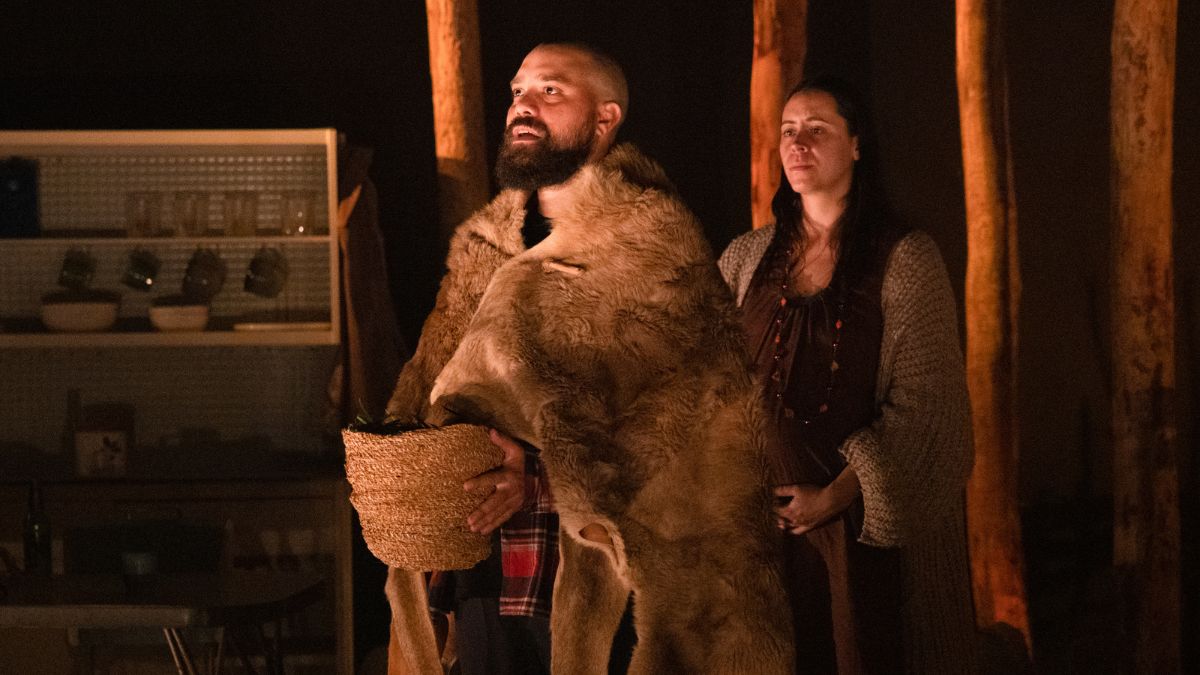
At What Cost challenges the notion of Aboriginal as a single identity, and pulls culture out of romanticised encasings that we so eagerly try to frame them in. It exposes the limitations we place on history when we call things artefacts and give them a tidy little plaque. Trawlwoolway writer Nathan Maynard allows truth-telling to interweave contemporary interactions with the stories of the past. The work unambiguously asserts that culture is a living breathing element of this world.
The setting is in Putalina (Oyster Cove), a culturally significant place in Lutruwita (Tasmania) where surviving Aboriginal people were forced to settle after removal from ancestral Country. I can recall an early season of ABC series Muster Dogs, filmed across various locations in the country with dual naming for all the mainland locations and a conspicuous gap next to the opening header for Tasmania that we now know to also be Lutruwita. At What Cost provides further cultural teachings that are evidently needed.
Yirra Yaakin expands the reach of this story to our beautiful Noongar Boodja, the theatre mob continuing to be a metaphorical warm fire inviting audiences to encircle it for a yarn. This time they bring a story that exposes the messy nature of healing and a heavy dialogue around identity.

At What Cost. Photography by Daniel J Grant
The set design by Matt McVeigh brought beautiful elements of Country inside which made it easy to forget we were indoors. Complimented by Matthew Erren’s immersive lighting that enabled an effortless flow of cast on and off the stage. Together the set and lighting took full advantage of every cubed centimetre of the stage.
Having attended towards the end of the run, the impact of delivering such a heavy show over subsequent nights had a visible toll on the cast. Which further serves the significance of this story and its need to be told. This was yet another example of the power of the immediacy of theatre.
Once again I leave the theatre after a Yirra Yaakin show with a deeper appreciation for First Nations cultures (this time Palawa) and a greater desire to learn Australia’s Blak history. I walk out of every one of their shows excited to share my learnings with anyone that will listen, with one of the first subjects being you, dear reader. Now get off this website and go figure out when you can get to one of these shows.