


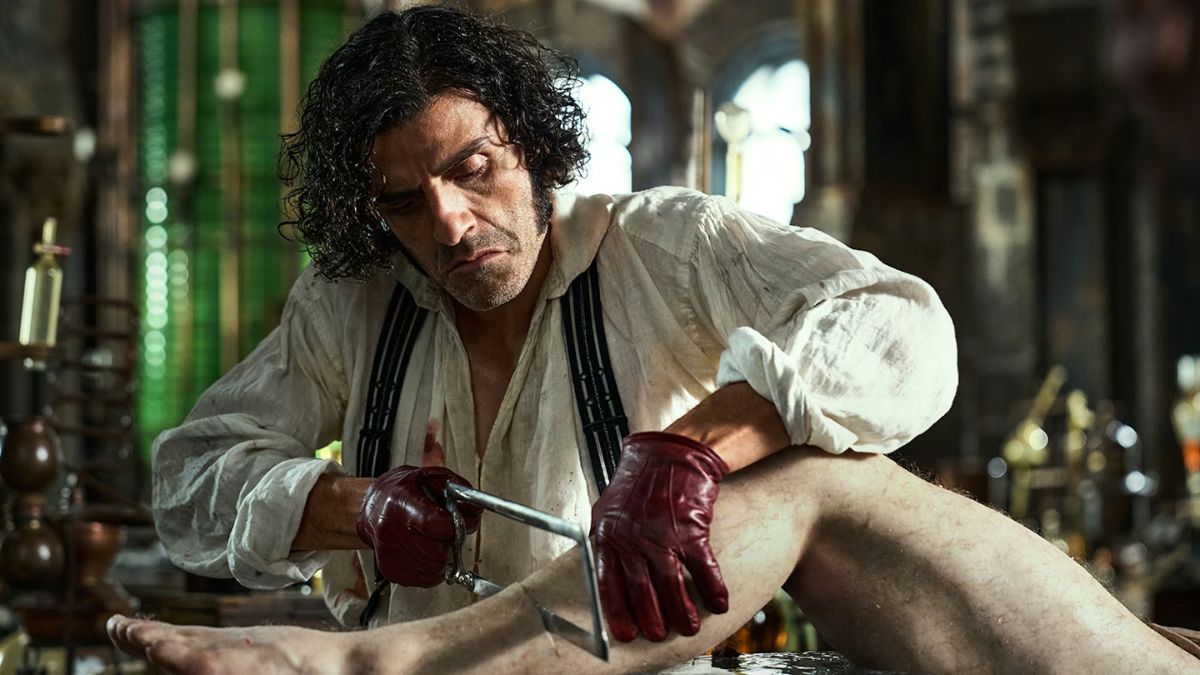
When Mary Shelly’s novel ‘Frankenstein’ appeared in 1818 she probably did not foresee it would become a classic of the horror genre with its appeal extending beyond two centuries. There have been many screen versions beginning over a century ago when cinema was still in its infancy. Guillermo del Toro’s interpretation is the very latest in a long line of these screen adaptations.
As a result, most of us are familiar with the title character: an eccentric medical genius who seeks to create an immortal being out of the corpses of the recently deceased using the power of electricity. In all the major screen versions, the plot is basically the same. Nevertheless, it retains a lasting appeal and this latest version does not disappoint.
To begin with, the story unfolds largely in flashback: a group of Scandinavian sailors are trapped in the arctic ice where they come upon the shattered figure of Dr Frankenstein (Oscar Isaac) who relates how he ended up in this waste land (as a gothic horror story, we can assume this will not be a ‘happily-ever-after’ tale).
Visually no expense has been spared with the elegant costumes, the decor and location scenes. The interiors include: impressive 19th century mansions, cobbled back streets, rickety farmhouses and that famous laboratory in a derelict tower. In addition, the special effects are also impressive and, at times, disturbing. One early scene where Dr Frankenstein is demonstrating his efforts in a lecture theatre is particularly confronting. These visuals enhance the competent acting of the entire cast.

Frankenstein, 2025. Directed by Guillermo del Toro.
Dr Frankenstein is the idealist determined to conquer death through medical science. Unfortunately, all those close to him suffer the consequences of his efforts. The tragedy is that he never foresees or intends these negative results. In this context, the characters emerge as credible individuals not the stereotypes of melodrama.
Even the creature has qualities we can empathise with: since he cannot die, he is alone in a hostile world which can never really accept him. (a hint at other marginalised groups in society). Furthermore, although he is an ‘unnatural’ being, the creature (Jacob Elordi) is not a hideous monster as in most previous screen adaptations. Apart from his initial parlour and a few facial scars he is not significantly disfigured.
Although this film contains violent deaths and all manner of destruction, this is not a simple gore fest. It explores issues of moral responsibility, specifically at what point should science involve itself with issues of life and death. If one can create a life artificially, where does responsibility for that life lie? Scientific experimentation can lead to all sorts of ethical questions and unanticipated problems.
Also relevant is how science has advanced since the original novel was written. Modern medicine has progressed rapidly over the last century; procedures such as organ transplants and stem cell research have led to the prolonging of life. While veterinary science can now clone various animal species. This progress adds another dimension to the Frankenstein theme: while still a gothic horror story, it now also has the element of science fiction.
No doubt, this will not be the last screen adaptation of the infamous Dr Victor Frankenstein and his unconventional experiment. Like the fictional doctor’s creation, this saga has taken on a remarkable longevity.
Its lasting appeal is that it deals with a truly archetypal theme: the quest to overcome our own mortality.