


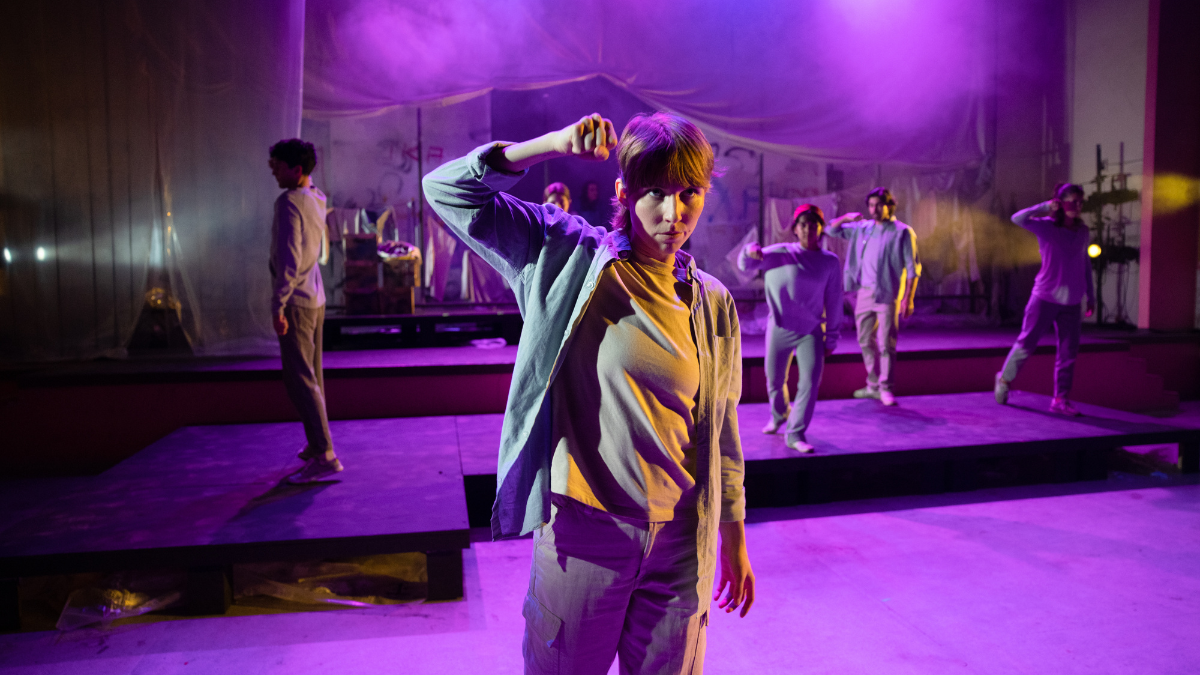
The Comprehensive A-Z of Missing Persons Australia, written by Grace Chow, and presented by WA Youth Theatre Company, takes a narrative and verbatim deep dive into the 56,000 disappearances each year. Most are found; some are not. The show jumps between a narrative through-line where Em travels through the story of her trauma following the disappearance of her friend Zee, and ensemble moments of heightened magical realism, absurdist spelling bees, and Greek chorus-esque reciting of names.
The ensemble takes on a range of functions, and each performer has moments to shine in well-directed and rehearsed segments where they find a strong cohesion. A through-line of the show is the presentation of the names of the people who are on the missing persons list with the AFP, working its way through the alphabet. The chorus recites name after name amidst the chaos of scenes. Although this does drop off after about F, I think, and instead is incorporated into projection for most of the alphabet, skipping over more letters towards the end. I did find this form effective at the beginning; it clearly worked to provoke ideas of the names, perhaps the same surname or first name of someone you actually know, but this effectiveness faded for me when it was clear there was no way they could work every single name into the show in some way.

The Comprehensive A-Z of Missing Persons Australia. Photography by Daniel J Grant.
Through the narrative arc, we see Em jumping between presenting her radio show and dealing with the ongoing trauma induced by the sudden disappearance of her friend. Em interacts with a kind of human embodiment of a Tasmanian Tiger, named Tassie. We get the impression Tassie isn’t real and is instead there to almost antagonise Em as a manifestation of her guilt. Tassie’s performer does an amazing job expressing this strange whimsical energy; it would almost feel fitting in a strange Lynchian dream sequence. Em recluses herself from people in the outside world, and perhaps this is showing us how people make that decision to pack up and leave, but the script seemed broadly uncommitted to this idea, and I wish it went further.
I found the strongest parts of the script to be the often brutal verbatim sections presented by a police officer who works in missing persons, Lauren O’Keefe—who created the Missed Foundation after her brother went missing—and a worker at Lifeline. They created a clear picture of the hurt and effort that goes into searching for missing persons and grounded an otherwise theatrical world in the reality of the tragedies. I would’ve loved to have seen more from the script around interrogating why people choose to go missing or what leads them to in moments of a mental health crisis. To me, this seemed the direction the show was heading, but it instead focused more on what going missing does to people around the missing person. Often, shows that raise awareness around a certain societal issue lack any meaningful call to action, but I will acknowledge the show ended in a very clear and explicit call to improve mental health infrastructure and to allocate resources in a more effective manner. Something I did find a little troubling from the show was sometimes a focus on the comparison of tragedies, as if some rank more traumatic than others. We had a brief explanation of ambiguous loss as an effect of a tragedy without a clear explanation, such as when someone goes missing and is never seen again, as if that is more a cause for focus than if a missing person returns. It also framed the statistic that of the 56,000 people that go missing, around half are youths, but I found the script lacking in really calling attention to why that is. Ultimately, I think Grace Chow does hit key points with effective power through verbatim, but the form and choice of certain through-lines bring down the effectiveness of the narrative setting of the show.
A-Z is an interesting work incorporating a strong ensemble of performers into a fantastical world, and while I don’t think the script quite achieves what it is aiming for, I think it does deal well in maintaining the reality of the tragedy of going missing and what that does to people around you.