


West Australian Opera has taken a bold new direction with its production of the Czech opera Rusalka. The Dvorak piece is based on the classic mermaid fairytale we are all familiar with in one way or another. There’s the original version where the protagonist chooses to put her lover’s life first, or the one from that capitalist cartoon cog machine that created the version with the Happy Ending(tm). You’ll have to go see this rendition to see how they spin it; I’m not giving any spoilers.
Opening with somehow ethereal and gloomy costuming, we meet the water gremlins in their mossy, moist sunken sanctuary. We’re immediately met with harlequin-styled trees dancing on the terrain with their quirky yet elegant movement, setting the precedent for the next 2 hours and 45 minutes. With clownish and colourful costumes that utilise vociferous shapes in both patterns and silhouettes, Renée Mulder’s costuming alone is worth attending this show for. You could hate the opera and still experience absolute delight with the imagery. The array of costumes showcases Mulder’s brilliance, from the bright and boisterous attire of forest enchantress Jezibaba and her associates to the sleek yet murky water gremlin outfits. The latter, whose white faces with contrasting black smudges around the eye complement the clownish aesthetic adorning the performers’ bodies.
The scene where Rusalka is stripped of her soul and voice and converted to a human so she can meet her homo sapien crush utilises metrically excessive materials worn by Jezibaba’s retinue. As they circle Rusalka to create a colourful cover for a costume change right on stage, white ribbons fly out from the inside of the circle to be caught in the air by Jezibaba, who smugly grabs them to stash in her trolley of eccentricities. Ashlyn Tymms nails the weird nomad aunt role that was clearly a crowd favourite who constantly revelled in her kooky yet classy demeanour.

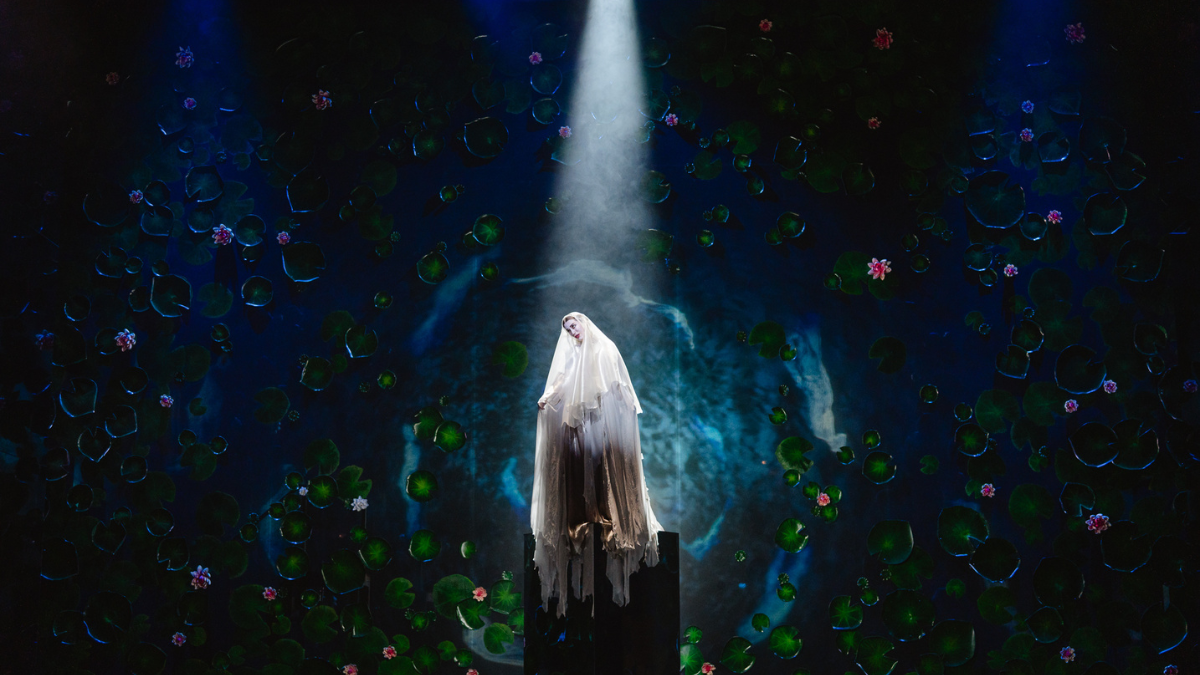
Elena Perroni in West Australian Opera’s Rusalka – image by West Beach Studio.
Using smoke and mirrors, and I mean that literally and figuratively, set designer Charles Davis expertly positions the story in the water, on the ground, in buildings, or in nature, or both and all of them as each scene requires. The full depths of His Maj’s stage are activated with every scene, whether that be underwater, on the ground, or both. The second act where the Water King meets The Prince is a particularly good example of how the stage is layered in a multidimensional way. However, it was the final scene that really won the crowd over, where the curtain opening was met with an audible gasp. I’ve never known the polite and timid Opera audience to have such a visceral reaction. The physical set design is accompanied by a modern technological touch from video designer and content creator David Bergman, whose projections bring a depth to the stage that doesn’t feel misplaced in the physical traditional art form. There is a scene in the final act where I can’t tell if the Water King is standing there in the actor’s physical form or as a holograph. It makes sense to be the former, but the fact that I speculated speaks volumes of how the video visuals seamlessly blend into the stage.
I’m sure you’re wondering how Elena Perroni plays a character that loses their voice in an opera. It seems counterintuitive, I know. But with the aforementioned mirrors, she gives a multidimensional performance with such poise and finesse that makes her performance beautiful from every angle. In the scenes where she isn’t singing, I’m still caught between which side looks more elegant between the one facing the crowd and the one facing the mirror. I’ve never seen such gorgeous movement in an opera, as directed by Lyndall Grant. It’s a multifaceted performance that is not all glamour, with one scene in the second act where the water spirit awkwardly tries to navigate steps in stilettos and a tight-fitting dress. Another scene where she meets her lover’s ex, the Duchess, while wearing the same dress in another comedically awkward moment.
With vivid costuming, breathtaking stage design, and mesmerising movement, this is a show that will entice newcomers to this classic art form and delight seasoned opera lovers. Having followed WAO for 18 years, I was excited to see the fresh takes in this year’s program and was looking forward to Rusalka in particular. My instinct was right, and I was not disappointed.
Rusalka is presented by West Australian Opera and is on at His Majesty’s Theatre from 18-27 July.