


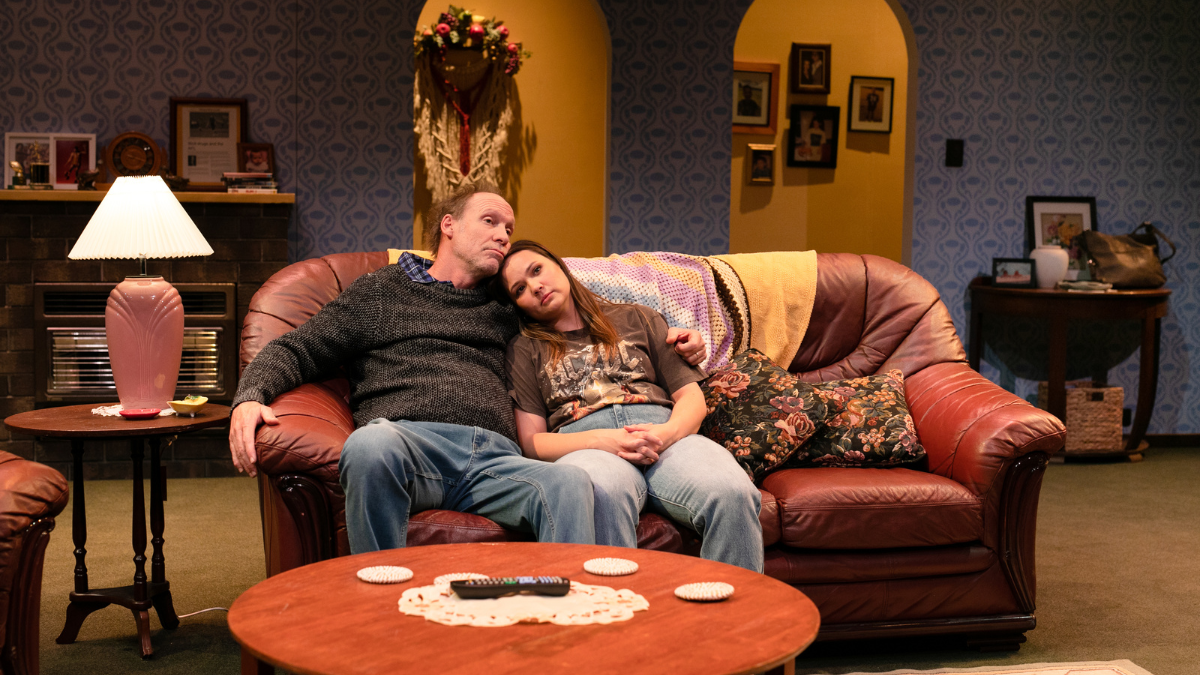
Andrea Gibbs’ heartfelt and brilliantly funny family drama, Barracking for the Umpire is back for round two following its debut in 2022. Inspired by her upbringing in Donnybrook, Andrea explores the intricacies and the repercussions of sports-related injuries on individuals, their families, and communities.
The show follows Doug Williams who is Donnybrook’s greatest footballer and he’s set to receive a lifetime achievement award. As his children return to the town to celebrate their dad’s award, they start to realise decline of his health, a fall out of his repeated head injuries.
In the lead up to the show’s return season, from 23 Apr – 05 May at Subiaco Arts Centre before a regional tour, we spoke with Andrea about its evolution, a screen adaption in the works and the rising discourse surrounding concussion in sports.
How does it feel coming back for round two of Barracking for the Umpire?
I reckon I’m pretty lucky, as a writer, that this story’s stuck around for a bit. That’s not something you see often in theatre. Getting to chuck on the guernsey again and share this production with more folks in Perth, and out in the country where it all kicked off, is an absolute treat.
This play marked your debut as a playwright, what was the experience like seeing this work come to life and hearing the response from the audience?
I was shaking, literally, the first night we had an audience. A feeling I had never experienced before watching a show. As the writer you have an image in your head when you are writing the story, others have their own image when reading it. When all of those minds come together, something magical happens. The story you see on stage becomes a real collaboration and unique to that particular cast and teams of creatives. Since that first night, I have loved sitting in the audience to hear the reactions. The audience is pretty vocal some nights, and I love that.
Since the show’s debut there’s been some development in the film space, with potential for an adaptation into a feature film. What can you tell us about that? How do you see this play adapting for film?
Yes, I am currently writing the screenplay with help from Screenwest, and in collaboration with Vincenzo Perella and Dan Osborn. We’re making really exciting progress and have a lot of confidence in the story.
While the stage play tells the story of the Williams family over three days, mostly contained to the family living room, the screen adaptation widens the scope to bring the town of Donnybrook to life, and to cinematically celebrate the rural community and regional footy itself.
As a cinematic story, we get up close with football. Really hear those hard knocks and we see fingers in the dirt. But the heart and the comedy remains.

Barracking for the Umpire Joel Jackson, Steve Le Marquand, Jo Morris. Photography by Daniel J Grant.
Last year the play was picked as one of three new works selected for a staged reading at the Australian Theatre Festival in New York. What was that experience like for you? Did you get a sense of how a global audience reacts to this piece?
Because it speaks to the universal experience of ageing, whether it’s grappling with our own fragility or that of someone we love, it really did resonate with an international audience – not just AFL fans. It was also really lovely showcasing a story that reflects how Australians, with our characteristic humour and a strong sense of community, navigate the most challenging moments of life – often with laughter.
Your dad was a key inspiration for Barracking. How did you work with him and other members of your family and community to include them in the writing process?
I made heaps of calls with Dad and also my brother Brendon who used to play for East Perth.
It was their turn of phrase that I was really listening for. Writing dialogue is all about nailing how a character talks. Sometimes, it looks a bit off when you are writing it down – but then you give it a voice, and suddenly, it reeks of realness. I love when my writing nails that. Maybe it’s the bogan in me enjoying a punt at the posh ABC accent we hear too often on radio?
How did the show evolve throughout the writing process? Was the end result how you initially envisioned? Did your research and conversations shape how the show developed?
My research into the effects of sports related brain trauma definitely influenced what I wrote – it wasn’t just about the medical bits, but how it ripples through families.
And for the person copping it, it can feel like they’re watching their identity slip away. For someone like my main fella Doug, who’s been all about footy and being a dad, it’s tough trying to grapple with turning into someone even he can’t recognise anymore.
I needed a way for the audience to understand what Doug was battling with silently and so the character of Coach was brought in. Doug uses a lot of energy to mask his many brain fades and memory lapses from everyone around him. Muscling into “help” him is Coach. Coach only exists in Doug’s ailing mind, and appears whenever Doug needs a pep talk. This guy looks like 1970s Aussie masculinity in tight footy shorts–think Ron Barassi’s moustache on Kevin Sheedy’s attitude. Unfortunately, his advice is an erratic mix of pump ups, taunts, and terrifying dressing downs.

Barracking for the Umpire Joel Jackson, Steve Le Marquand, Michael Abercromby. Photography by Daniel J Grant.
Did you find that your other experiences on stage with performing helped you through the writing process?
Being an actor myself, I really wanted to make sure all the characters were fun to play. Nothing’s worse than being stuck onstage night after night in a character that you just can’t get into. That was definitely on my mind.
Picturing these characters was pretty smooth sailing for me – probably because they’re a lot like my own family. I’m working on a new play right now and finding it a bit tougher to get the characters just right, but I’m taking my time and staying patient.
I also thought a lot about what I love most about theatre – and it all comes back to relationships being played out right in front of you on stage. And some good blow-ups.
With the recent early retirement of Angus Brayshaw and changing concussion rules in the VFL, how do you see the conversation around head knocks and concussion changing culturally?
Things have shifted a fair bit since my Dad’s playing days. Concussion protocols back in his day were, “Can you walk? Can you talk? Get back out there. Do not let them see you hurting.”
I think there is growing awareness and understanding around the impact of hard head knocks for sure. I’m hanging out to see how the AFL tackles concussion as the game becomes much faster. And I’m all ears for what comes out of that big class action the ex-players kicked off last year.
Do you feel like writing this play has changed your perspective at all on the game?
I read more AFL news than I used to, something I’m actually trying to dial back on now. It can totally take over your life if you’re not careful.
Are you developing or writing any other works we should keep an eye out for?
Yep – I am back in the torture seat. After riding the success of ‘Barracking’, I somehow forgot what a slog writing can be. It’s no fun for me. The fun only kicks in when I’ve managed to get some decent words down, and we start reading them out loud around a table.
The idea for my new work started with a character – Carol – she’s hitting her late 50s or early 60s and found herself living out of her car. Sometimes, once you’ve got your character sorted, they pretty much take the wheel. Carol’s gearing up to spill her guts soon, so watch this space.
Barracking for the Umpire presented by Black Swan State Theatre runs from 23 Apr – 05 May at The Subiaco Arts Centre. The show will then head on a regional tour to Albany, Broome, Esperance, Geraldton, Karratha, Mandurah, Margaret River and Port Hedland from 11 May – 15 June.