


The doors of PICA are set to swing open once again after dark, welcoming audiences to its second season of performances, RESTORE. The eclectic programming that PICA is known for is ever-present in this season, presented by STRUT Dance, which features a double bill of contemporary dance works: Mickey by Brooke Stamp and CALL by Ainslie Allan. Each work examines the body “as a site of memory, transformation, connection and repair.”
CALL is a world premiere, created in collaboration with Annika Moses and Jo Pollitt. I spoke with Ainslie about their collaborative practice, the origins of the work, and its exploration of grief.
Your work is grounded in enduring collaborations. Can you tell us what this means and what this looks like to you?
I’ve known Jo Pollitt since 2013 and Annika Moses since 2019. My collaborations with them have included a variety of professional contexts working together, but also conversations that we sustain together over many years. In this way, enduring collaborations are long-form listening, dialogue, a natural ebb and flow towards/away from one another in shared creative community, the ongoing navigation of friendship and life events amidst our artistry, and a trust that creative threads we share will naturally accumulate and intensify at certain moments, because the work between us inevitably needs to culminate and be expressed. Jo and I actually have a Performance Research Journal in ‘On Score’ being published later this year that articulates this in detail; it’s about lineage and about the way our artistic practices reciprocally inform and evolve across generations, artforms and time.

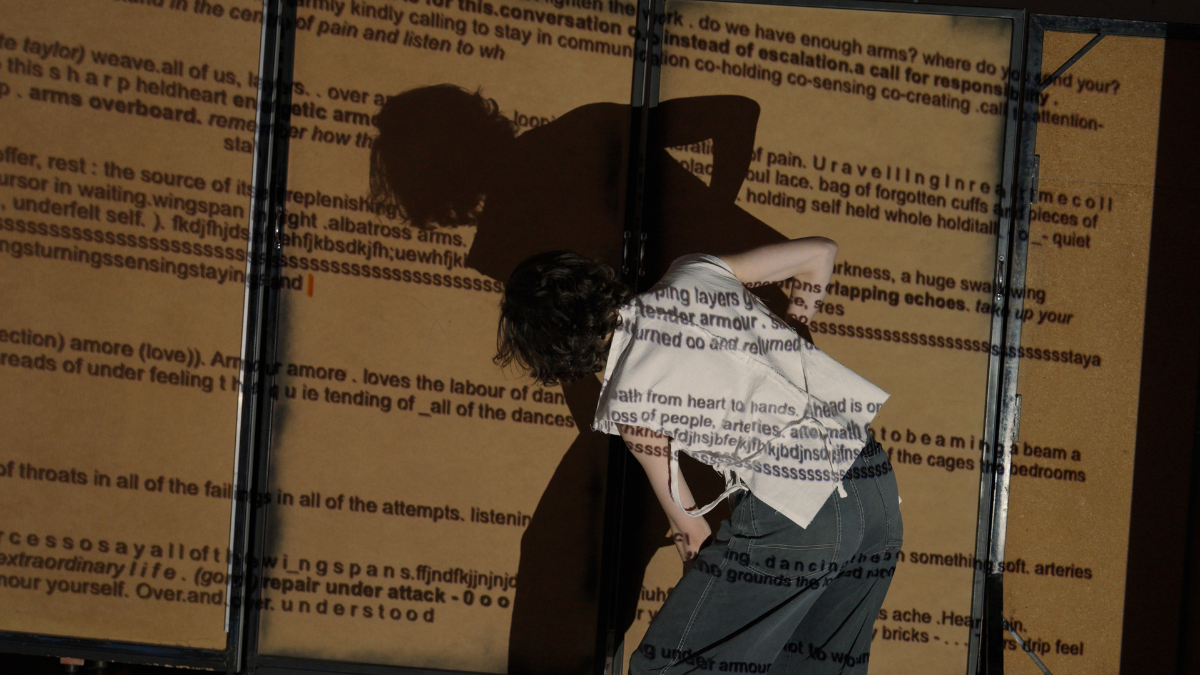
CALL by Ainslie Allan. Photo Credit: STRUT.
What are the ingredients/elements that make for a great collaboration?
Long form trust and exchange, as above. Also the courage to push and grapple honestly, the skill to disagree, to relish each other’s process and perspective even, or especially when(!), it contrasts to our own, the ability to play, to wander around, to not know yet, to allow things to slip away or disappear (they’ll come back if they need to) and especially to laugh at ourselves, together. ‘Hold on tightly, let go lightly’ is a good saying – I heard it via the Viewpoints method. I also collaborate with people who share my commitment to artistic experimentation and to a whole-self knowing that we are striving to do something valuable and transformative. Kindredness in drive but also in humility, generosity and a healthy dose of irreverence.

CALL by Ainslie Allan. Photo Credit: STRUT.
Tell us about this work CALL. Where did this journey begin?
It’s hard to trace exactly – there are multiple origins in my thinking and many enduring continuums in my artistic approach that are coalescing in this work.
I’ve been dancing gigs in improvised performance with live sound artists for the last decade, mostly in grass root experimental sound platforms such as Outcome Unknown and Tone List. In March 2025 WWIM hosted one such event where I played with valued collaborators and farewelled my life on Noongar Country for a new opportunity in Lutruwita. Unexpectedly, that experience, along with my whole 2025, turned out to be exceptionally difficult with compounding challenges and loss. CALL is therefore a work of re-realising the artistic connections and practice that feel most important to me, it’s a homecoming to Boorloo, Noongar country – a place and creative ecology I love and feel deeply invested in, it’s a return to my body and my voice in an act of restoring, recalibrating and transforming.
During my months of recovery, I read Sarah Schulman’s ‘Conflict is Not Abuse; Overstating Harm, Community Responsibility and the Duty of Repair’. The book powerfully affected my understanding of self-responsibility (ie. acknowledging one’s own contribution to complex events), and how essential it is that we collectively support communication and repair instead of avoidance or blame, which escalates tension and deepens division. I wrote a poem in 2021 ‘why do they call it, a call to arms?’ which grappled with this, with how to priortise listening, helping and moving toward one another above anger, violence and othering.
The name of this work became CALL when I realised how much I was expanding my improvised dance practice to integrate vocalisation. Singing, sounding, screaming, shouting, wailing, breath, crying, calling: there are so many vocal textures that have become integrated in the way I move and have added such range to my artistic expression. It’s a cathartic and healing activity on an individual level, and the mouth is a key place of transmission between our inner and outer worlds. I’m also passionate about how the resonant voice is an offering to recognise our collectivity, care and power. In his book ‘Lexicon of the Mouth’, Brandon Labelle writes “the raised voice resolutely calls toward a greater arena of collective rapture, social gathering, shared spirit and divine communing. The sonorous energies of vocal outpouring… the energy commanded by the ability of the body to sound, to breathe so much melodic and emotional life into its vocality… longingly aims to conjure more than itself.”

CALL by Ainslie Allan. Photo Credit: STRUT.
The performance explores grieving, or grieving-as-we-go. Where did this theme come from and how have you explored it further in development?
I have an exceptionally vivid memory for feelings, events, details and the exact words that I, or other people, say. (I’ve heard that some autistic people can recall every single day of their life and I suspect I might have about 75-80%!). I remember the moment I first said the term ‘grieving-as-we-go’ – it was in Maylands Town Hall when I was an artist in Last Great Hunt’s inaugural Gatherer’s Collective. We were discussing the accumulative magnitude of geo-social-political challenges, my preference to welcome and relish grief/allow big emotions to pass through me (rather than reject or suppress) and the possibility that ongoing flow of processing these through arts practice might be needed for our bodies to live and function in an increasingly complex, challenging world. Pain and joy are both very intense for me, and I find them to be curious and rich experiences. I’ve not met anyone who wants to explore full feeling-ness in the way that I do.
Grief is the flipside of love; it’s a measure of how very deeply we’ve been moved, how much we care, how alive we are. During development of CALL, I’ve listened to insights by Harvard neuro-scientist Jill Bolte Taylor who passionately echoes this sentiment and, after observing herself having a 4-hour stroke at the age of 37 (then 8 year recovery), writes about how emotions are processed in four hemispheres of the brain. What I’ve found curious is that much of our grief, distress and pain are stored as overlaid memories, experiences and patterns of the past. Our most visceral emotions are often borne from this, rather than in response to what is actually happening. Then there is a separate part of the brain that gages safety and sensation in the current moment, and these two parts of the brain can be in harmony or at odds with one another. I’m wondering if the deep presencing that happens in live improvised dance and vocalisation, the flow state, the detailed listening, the transcendence of past and future, can be a key to understanding ourselves, all that we carry and how we relate to one another with more compassion. Ros Crisp (esteemed dance artist who has influenced both Jo and myself, among many others) once said to me “the body moves things through”. I’ve realised why I dance often – in all moods, furiously, quietly, constantly, as much as possible – to keep grief moving and to balance that with all the other consciousness and emotions that make being human fascinating and good.

CALL by Ainslie Allan. Photo Credit: STRUT.
The performance features live-generated choreography, what form does this take in each performance?
That’s another hard question to answer, because it takes many forms.
One thing that’s clear and reoccurring, strongly influenced by my work with Jo over the years, is finding ‘states’ for my performing body to inhabit. These are energetic worlds of movement where my moment-to-moment sensation and imagination are heightened and busy in a very specific way. The movement has a recognisable tone and identity but the exact shapes my body makes are created in an unfolding continuum due to my deep absorption in the ‘state’. It’s almost as if I am eternally searching for (and often never quite finding), the dancing that can adequately capture the intensity of alive-ness that I’m summoning/connecting to within myself.
Another example, specific to CALL, is a score called ‘arms’ in which I loop and pass through a series of evolving, rocking gestures. They begin as somewhat arbitrary shapes but then a distinct emotion, human action or image emerges. I challenge myself to find and welcome these these but as soon as they take shape and become recognisable, I let it go and change.
Working in this way is very stimulating. It asks that I catch my own habits and challenge myself constantly. It demands that my awareness functions on multiple levels at once. I am trying to genuinely not know, change unexpectedly, but also build a dance of continuity and composition (ie. sense of how my improvised choices affect shape, pattern, motif and arc in the whole of the work). Live-generated choreography is something I am deeply busy with in both mind and body; I am truly seeking something, striving in the moment, not necessarily achieving or arriving but constantly refining clarity of the pursuit and maintaining commitment. This is offered with an awareness that audience might be compelled by both the shapes that emerge, the charge in my mind/spirit and the vulnerability of how real it is.

CALL by Ainslie Allan. Photo Credit: STRUT.
What would you like audiences to take from this work?
An appreciation of how live, deep, exploratory and multiple creative process is. Jo’s writing, Annika’s sounding, my dance and vocalisation – they are all happening and evolving in the performance, continuuing to layer every night.
A feeling of being shifted, maybe moved – not needing to understand with the mind or finalise exact answers and meanings. In CALL audience are invited to sink into the atmospheric offer of the work and notice how it affects them.
An implication to be part of collective calling, constancy and co-authorship. A recognition of the labour it takes to mend, to feel, to keep untangling and sewing things back together, to keep meeting rupture and repair. We can co-define what the call of this moment needs to be. The audience’s sense of what the work is calling for is welcome, along with what they might be aching, yearning, hoping, calling for in themselves and in this time.
Can you give us five words to describe CALL?
Resonant, persistent, open, expressive, tender-attending (did I cheat a little bit there?)
STRUT Dance partners with PICA to present RESTORE.