


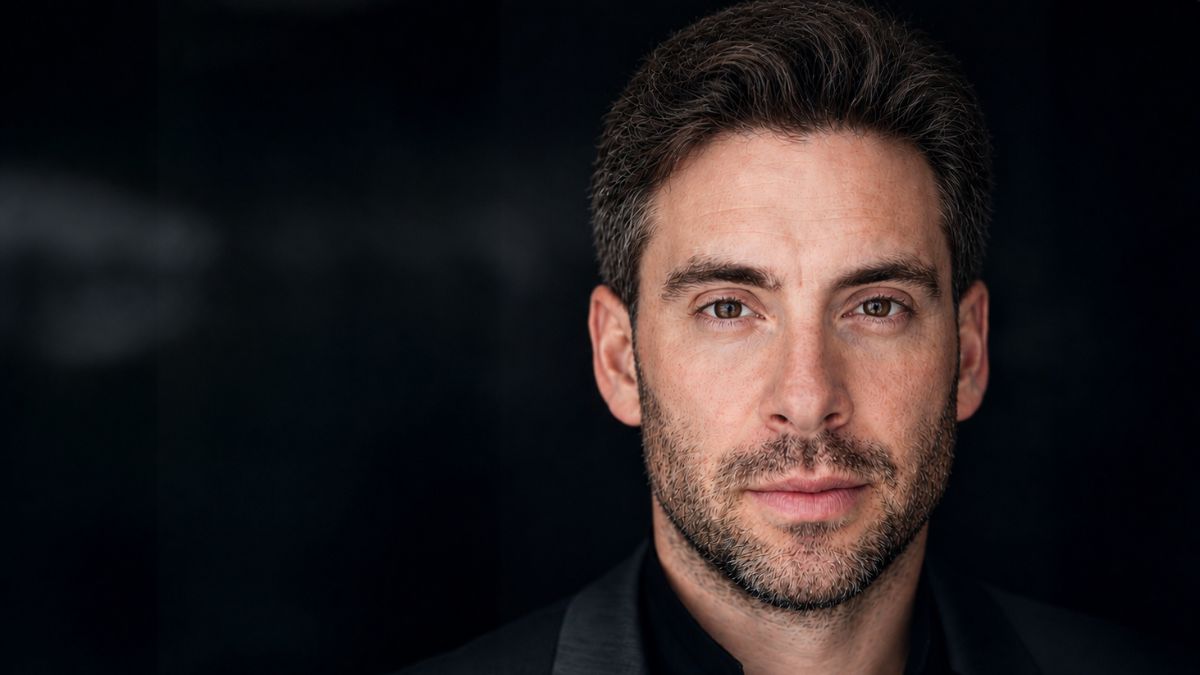
From an aloof flirt with a senseless streak to a remorseful and regretful soul, across the three acts of this gripping opera the story of Eugene Onegin unfolds.
From Northern Ireland to Western Australia, director Cameron Menzies brings his adaption of this classic tale to Perth’s audiences. Australian baritone Samuel Dundas has takes on the titular role, 12 years after initially understudying the role. We spoke about his artistic processes, his musical upbringing and interpretation of this iconic role.
Welcome back to Perth! You were last here in 2025 performing in Madama Butterfly. What did you enjoy most about that experience and performing for Perth audiences?
Perth audiences are always so generous and receptive. I’ve been singing here since 2015, and honestly think some of my best work and best professional experiences have happened on the stage here. Collaboration is the key to this art form and ego is the great underminer of that process, and I’ve always loved the company’s ability to keep ego away from the rehearsal room and thus the end product.
You’re returning to take on the titular role in Eugene Onegin. What was it about this specific character that drew you to him?
Onegin is one of the very few roles I’ve had on my bucket list, so to finally have the opportunity to bring him to life is a real thrill. Fortunately, I learned the role 12 years ago to understudy it, so a lot of the heavy lifting regarding the language and character has had over a decade to ferment. Familiarity is the key to feeling comfortable in big roles like this and when you learn it right before, it doesn’t always inhabit you in the same way. In terms of the character, he’s divisive. If we identify with him using modern sociabilities, we think how cruel he can be, but actually there is a sense of honour that can be lost. I think it’s important that people understand him. They might not agree with his choices, but that he makes them from a point of integrity is far more relatable.
Throughout the opera, Onegin experiences a massive emotional arc, only realising what truly matters to him when it’s too late. How do you navigate such complex, evolving feelings in your performance?
I feel like there is a lot of me in the character. Always trying to do the right thing, but not always succeeding. I think when one can identify with the character they are playing, or even in parts of them (lots of opera characters you wouldn’t want to identify with), then there is an honesty and vulnerability that becomes available which gives a broader, more robust characterisation. From a singing perspective, I’ve learned the hard way, how honestly to feel some emotions on stage, because in many cases they completely change the way you’re singing, because they alter your breath, your face and mouth positions in a way that doesn’t always help. Finding the emotional truth of the character has to happen in the rehearsal room, so you can then show it, without necessarily “feeling” it, during the shows.

Production images courtesy of Northern Ireland Opera
What is your preparation process like for a monumental show like this? What kind of research do you dive into, and how do you mentally step into the role?
As I mentioned, having learnt it 12 years ago and subsequently understudying it again for Opera Australia earlier this year, much of the heavy lifting was done. Russian is a great language to sing in, but a very hard language to learn. Given my schedule and other commitments, like my family and my university studies, I wonder whether it would have even been possible to get all the Russian learnt and in my head. From a vocal perspective, there is a certain style of singing that I’ve always wanted to use to portray Onegin and I was able to build that singing into the show I finished just before Onegin started, which meant I was getting my reps up whilst singing a different show.
How to mentally prepare is such a good question. I’ve not always invested enough in this area of my preparation and it’s only in the last few years as I’ve begun to teach and mentor that I’ve been able to really begin to understand what a priority it is and needs to be. Even a token session of self-care in the lead up to big shows is incredibly important, to ground you and arm you with the sense of resilience and motivation that it takes to go and grab the bull by the horns each and every night.
Looking back, could you take us to the very beginning of your opera career? How did it all take off for you? Coming from a musical family, were you always drawn to this path?
Music was always in our family. Mum made sure my brother and I were both exposed to it from an early age. My journey with singing didn’t start until late at high school and even then, I was pretty reluctant. As a kid who’d experienced a lot of bullying throughout my school life, when it was suggested that I have singing lessons, I thought it would be social suicide. It should be said that this was well before Disney’s High School Musical made it well and truly cool for the boys to get up and sing. My mum worked at the school and got the singing teacher to pull me out of class one day and it all snowballed from there. I reluctantly studied music at university and then quickly found my way into developing artist programs and Victorian Opera and Opera Australia. Even then though, I was still completely unsure what I was doing or if I really wanted to do it. It’s a great example of natural talent not being enough. It took me years (and a lot of very influential mentors) for me to understand the “gift” I had been given and how to take responsibility for it.
What element of performing on stage do you love the most?
For me it is always storytelling. I’m acutely aware that we are performing in an audio/visual world and that beautiful singing and music alone are no longer enough. Whilst we have to sing in tune and sing in time, when we are convincing as characters, the often it completely overrides the detail of the singing, because we get swept up in the story and the lives of the characters. As an audience member, I want to be moved, transported. Music can do that of course, but in opera, it’s the story.
Beyond this production, where else will 2026 take you?
After Onegin, I get some time at home, which is terrific and a chance to finish my studies. Then in November, I’m heading to Sydney to sing Gunther in Sydney Symphony Orchestra’s Götterdämmerung, the final chapter in their multi-year presentation of Richard Wagner’s The Ring Cycle. Having had the privilege to sing Donner in the opening opera, Das Rheingold in 2023, the opportunity to return and complete the cycle, in a new role, and under the baton of the incomparable, Simone Young, will no doubt be a career highlight.
You can see Samuel Dundas in West Australian Opera’s production of Eugene Onegin from August 6 – August 15.