


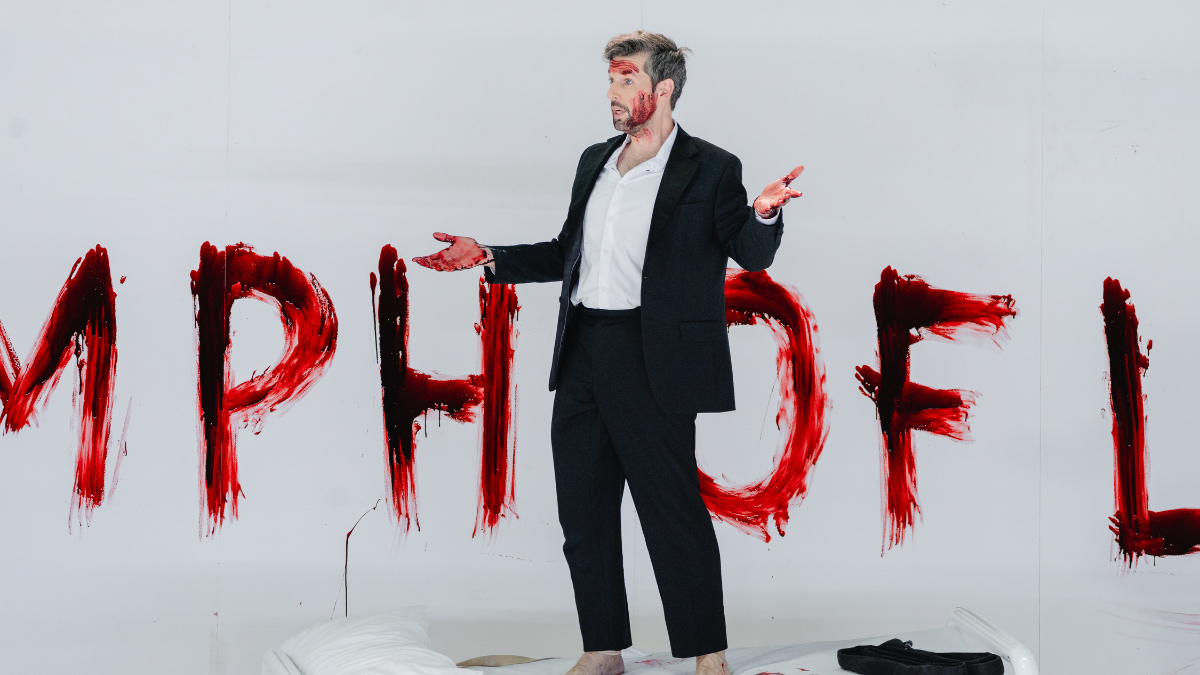
The concept of combining opera and circus already defies expectations for presenting a Greek myth such as Orpheus and Eurydice. However, director Yaron Lifschitz doesn’t rely solely on gravity-defying stunts or a masterful score to entertain—or rather, to shock—his audience. Instead, he brings an unexpected depth and complexity to this centuries-old tale.
I was warned before the show that there would be gasp-out-loud moments, but I didn’t expect this to happen as soon as the curtain lifted. Immediately, we get a taste of the highly skilled performances from the Circa ensemble.

West Australian Opera’s Orpheus & Eurydice © West Beach Studio.
Russell Harcourt is unsettling as the broken Orpheus, consumed with grief and sent into a state of delirium. Waking in the setting of an asylum, his voice radiates with anguish as he calls out for his beloved in confusion over what has happened.
The 16-person WAO chorus is an ominous presence on stage. Dressed in military-style boiler suits, they watch Orpheus with indifference. Meanwhile, the Circa ensemble continues to astound the audience with stunts that take our breath away, portraying the story on a grand scale.
When Prudence Sanders enters as Amor, resembling Eurydice, there’s an unsettling gleefulness about her Hollywood starlet-like character, ready to take centre stage. Bridie Hopper’s choreography in this section is particularly engaging, and Sanders rises to its demands, swiftly moving and even climbing around the stage.

West Australian Opera’s Orpheus & Eurydice © West Beach Studio.
After learning he has a chance to revive Eurydice but must not look at her in the process, Orpheus begins his descent into the underworld. This part of the show stands out through the collaboration of all performers. Both the WAO and Circa ensembles merge and move together as the supernatural Furies guarding the entrance to the underworld. I also appreciated the clever yet simple set change, as the Circa ensemble rolls out fake green grass forming a circle, taking us away from the asylum setting.
In Act 3, Eurydice is tormented by Orpheus’ refusal to look at or explain his actions to her. The sense of feeling trapped emanates from both principals as they each embody their character’s pain. When Eurydice finally persuades Orpheus to relent and look at her, there’s an almost palpable sense of relief. Through a beautiful sequence, Orpheus gazes upon her, and a tender moment unfolds—only to slip away again. This all transpires within Orpheus’ imagination, with each moment unfolding with the surreal, nonsensical quality of a dream.

West Australian Opera’s Orpheus & Eurydice © West Beach Studio.
The production’s conclusion embodies a crescendo, with audience members unable to hold back from gasping or audibly sharing their thoughts. Harcourt’s entire demeanour as Orpheus shifts to one of delirious happiness; the transformation is remarkable. It’s hard to imagine anyone forgetting the final image of a blood-strewn wall and a strung-up Orpheus.
Orpheus and Eurydice feels like a fully realised production that doesn’t skimp or cut corners. Lifschitz’s ideas are meticulously executed. There’s a strong momentum throughout, keeping the audience captivated and unwilling to break the spell with an interval. The performers’ endurance reflects their characters’ battle and persistence for love.
Orpheus & Eurydice is playing at His Majesty’s Theatre from October 24 – November 2.