


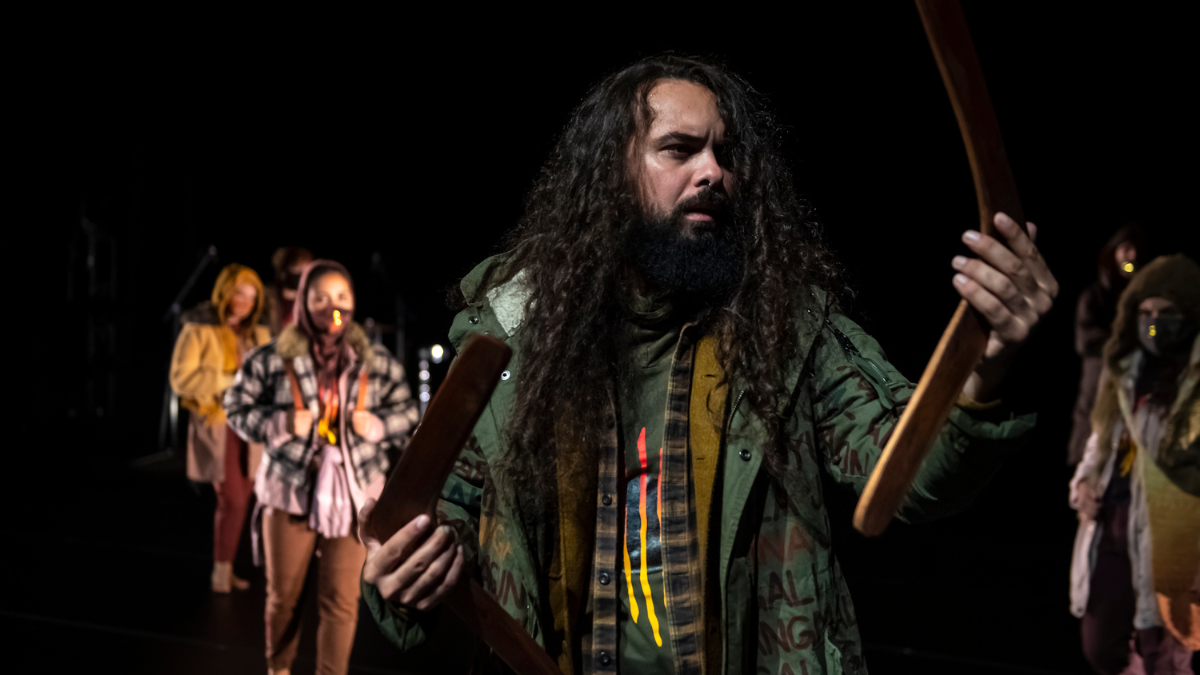
Disrupting a silence that has lasted over 250 years, choreographer Thomas E.S. Kelly’s latest work, SILENCE, places the Treaty conversation at the forefront, ready for interpretation by a new generation. Presented by Karul Projects, SILENCE promises to deliver a performance full of reverberating power, with live drumming and raw physicality. Ahead of the show’s run at His Majesty’s from May 1-2, we had the opportunity to speak with Thomas about delving further into the Treaty conversation, balancing heavy themes with subtle humour, and navigating his roles in choreographing, directing, and performing in the show.
What’s the process been like in creating SILENCE? How long has it taken from conception to stage?
We started Karul Projects in 2017 and began work on SILENCE in 2018. We premiered in 2020 as part of Brisbane Festival, at Brisbane Powerhouse and began our 19 venue tour in 2022-2023 and now on our final leg at The Maj in Perth and Sydney Opera House.
You’re in a triple role of choreographer, writer and performer. Is there a role out of these three which you find dominates the others? How do you balance them?
For me they all work together. Each role has its moment of being dominant, what I find important is making sure that each role is respected. Each role demands its moment to be crafted and it’s a balancing act but I love it and I think because of that is how I’ve managed to make it work, at least for this time as I now factor in being a father of 2 for future projects.
The conversation of a Treaty has recently heightened in public discourse prompted by the Voice referendum, what impact did this have on the work?
Treaty is the conversation I want moving forward, but people fear the blak agenda. People fear Treaty and what it could mean, not even understanding what benefits it could bring for everyone, to create an identity for Australia that is grounded in and respects the First Nations history of the land we call home. SILENCE provides an entry point for audiences to see what a Treaty could bring, yes the hard work and pain of acknowledging what has happened to the First Nations, yes putting in place processes to have us at the table, but also then the joy of strengthening two cultures together First Nations Australia and Colonial Australia. We aren’t one and Australia is littered with racism still, because people don’t know how to coexist together. Because they never had to, there’s no agreement, there’s no Treaty.

SILENCE by Karul Projects. Photography by Gregory Lorenzutti.
Can you talk us through the significance and meaning of the title SILENCE and how it connects to the piece?
SILENCE is not silent. We are breaking the silence. Even when you think the conversation is not being spoken about, people are still fighting for and talking about these issues for First Nations people.
Treaty is an ongoing conversation that started way before me and because we still do not have one it’s our responsibility to keep the conversation going, to not be silent. There’s silence in the dancer’s energy when they hit the cut in traditional dance, there’s silence between the stars as the Emu travels across the night sky. It’s the space between. It’s also the deafening SILENCE under White noise. We have marched across our Country. We have had promises made and promises broken.
A live drummer joins the performers on stage, what led you to bring live music into this piece and how does it contribute to what we’re seeing and feeling on stage?
Live percussion through the use of a full drum kit, is representative of the possum skin drums used in my mobs ceremonies. It became a response to people telling me I should use didgeridoo in my work to sound more “authentic”, my mob didn’t originally use didge, we used drums. It then became a representation of the heartbeat of country, and country telling us what needs to be done, guiding us through the story.
While SILENCE addresses serious and significant moments in Australian history, there is still humour and brightness in the piece. How do you balance contrasting tones and themes through your works and why is it important to keep some humour in a piece like this?
It is part of all work I make – serious work with heavy themes, balanced with subtle humour. To make sure that it’s accessible to everyone. So, the audience can engage in the work. For example, the boomerangs used as a musical instrument in the work have a dual purpose; exposing the fake production of Aboriginal items as well as being a message stick of ceremony and songline. There’s important messages being shared throughout the work, verbally and physically, and so I believe if people are laughing they’re listening.

SILENCE by Karul Projects. Photography by Simon Woods.
Can you tell us about your creatives and cast? How did you build your team for SILENCE?
In the beginning it was a lot of first time collaborations happening, which during the development and premiere developed some really strong relationships which have rolled onto future projects.
During the 2023-24 tour SILENCE became an all First Nations cast, which as a First Nations led company was really important for us and the stories we tell.
This work and collaborations with people both on and off stage became really strong which I believe is reflected in the work and story.
What conversations would you like SILENCE to prompt and inspire?
SILENCE is about continuing the conversation about a Treaty. We hope that more then just saying the show was about Treaty the audience are left with a little bit of knowledge about what a Treaty could potentially achieve. SILENCE aims to prompt these conversations so that the Treaty yarn never goes silent.
SILENCE presented by Karul Projects and presented by BlakDance is on this week, May 1-2 at His Majesty’s theatre.