


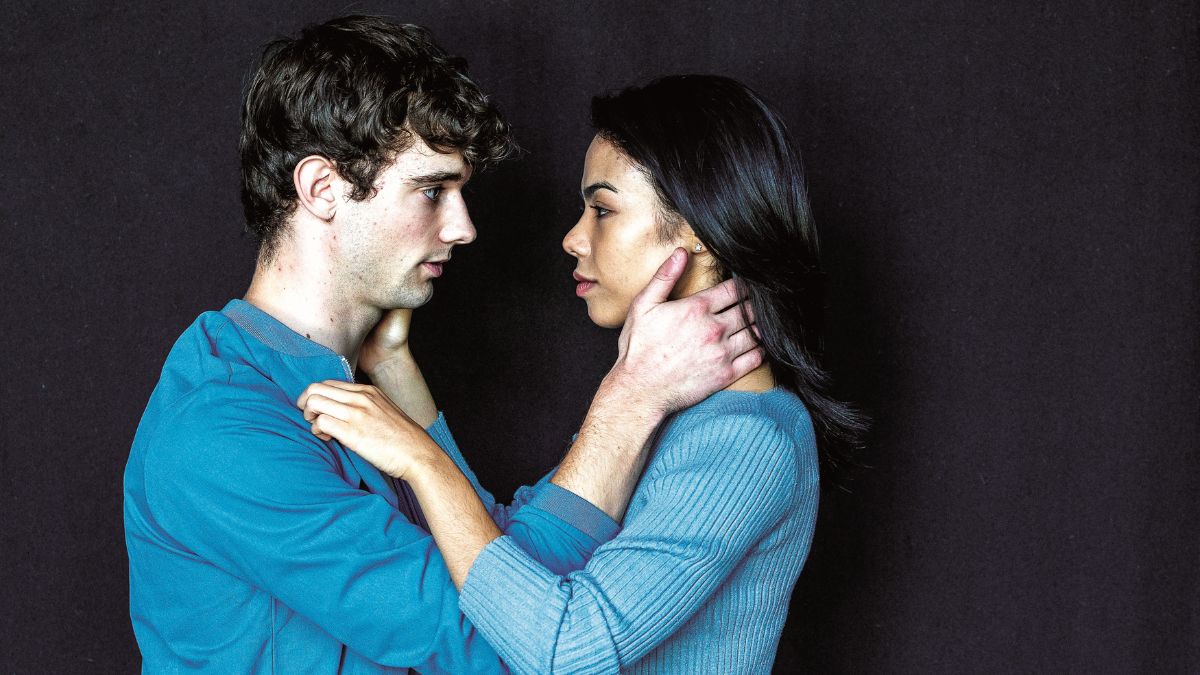
It’s a tragedy that has gripped audiences for more than 400 years, with its themes of love, loyalty, and the brutality of humanity remaining relevant today. Romeo and Juliet is the main production for this year’s graduating Acting students at WAAPA. Known as their ‘heightened text’, the production represents the culmination of the cohort’s training, showcasing their skills and strengths to audiences before graduation.
Hailing from the Philippines and Hobart respectively, Holly Samaniego and Griffin McLaughlin spoke with Magazine 6000 ahead of opening night. We discussed the direction this adaptation will take and how their three years of training, along with the connection they have developed, have prepared them for these roles.
Take me back to when you found out you were doing Romeo and Juliet. What was your reaction?
Holly: I was really happy to get a Shakespeare. There’s no guarantee you’ll get a Shakespeare as your heightened text. I really wanted to do a Shakespeare. Romeo and Juilet is a classic everyone knows it!
Griff: Similarly I was really excited, everyone has some connection or experience with Romeo and Juilet.
Holly: It’s very deeply relatable because it deals with love and young love.
Are you casting your minds back to when you were that age to get in character?.
Holly: What we’ve done is aged up the characters. In this version Juliet is around 18-20. Somewhere closer to our actual ages. But that sense of excitement and crushing on someone very deeply is something that I look back on, to get into character.
Your Director Tom Healy is adapting this production for a 21st century audience. What are the parts that make it for a 21st century audience?
Holly: The staging, it’s a bit more raw the way that it’s cut. It’s been truncated quite a bit so it’s more of a muscular version than the original play. The original language has a lot of beautiful language in it but it kind of distracts from the show. I think to go from a four hour play to then a one and half version means the audience gets all the juice.
Griff: The play takes a normal part of growing up, like falling in love for the first time and sets it against ancient cycles of violence. I think that’s always resonate whenever this play gets performed.
What are some of the challenges working with this text or this adaption?
Holly: The poetry helps unlock emotional connection to the story but then the challenge becomes meeting the language where it’s at and you want to be able to serve it and let it soar, not downplay or trivialise. There’s the challenge of wanting to make it sound like people are just talking and let the language work for itself but also ensure it doesn’t feel underplayed.
Griff: It’s a lot more muscular to how we use language now. We balance how we communicate now and how actors speaking this text communicated 400 years ago.What did these words mean then?

Photography by Kathy Wheatley.
How have you two built your connection on stage?
Holly: The two and half years have helped a lot. The fact that you are in a continual working process with the same people over again, I’ll probably miss that the most when we graduate. You know each other, what you’re prone to, what behaviours each other have and you can make each other look the best.
Griff and I are both movers in the class. We’ve been connecting through our body language and how to touch as characters who are newly attracted to each other and actually that’s challenging.
Griff: We’re tracking that unfamiliarity to familiarity. I think rehearsing, doing classes and performing together for two years helps a lot. We’ve also got a check in and check out process, we’re stepping into this world and then back out of this world again. That’s really helpful.
Holly: I think it’s a good standard practice that actors do when two characters are in really heightened situations with each other through violence or love, anything like that. We check out so we don’t take home what happened on stage.
What’s the most rewarding thing about working on this production?
Holly: I feel like this is the fruition of all my learnings thus far from WAAPA. I see the good habits I’ve developed and the tools I have now to be more efficient at the work, to interrogate texts and play more deeply now. The fact it is a Shakespeare demands a lot of text work, demands a lot of body work and conditioning. It feels like the fullness of everything that I’ve learned for two and half years.
Griff: Doing Shakespeare, you get to do all the things that we train on. That’s really rewarding to do a day of rehearsal and hit on everything, developing all different parts of my craft.
What are you most excited for audiences to see?
Holly: I think Juliet is a fun role because she’s always surprising. She is quite raw and deeply flawed but also really intelligent and a bit feisty. I’m excited for people to react to this interpretation.
Griff: It’s a very physical show and it’s exciting to do group movement. I’m keen to hear how audiences respond to that. We’re exploring new stuff and it makes the production unique.
Holly: I’m excited for people to see the grittiness and the ugliness of the production. I think the play deals with the violence and circumstances so transparently. It doesn’t make things pretty. I’m excited to see the reaction to the ugliness.
Romeo and Juliet presented by Western Australian Academy of Performing Arts is on at State Theatre Centre of WA, Heath Ledger Theatre from June 12-17.