


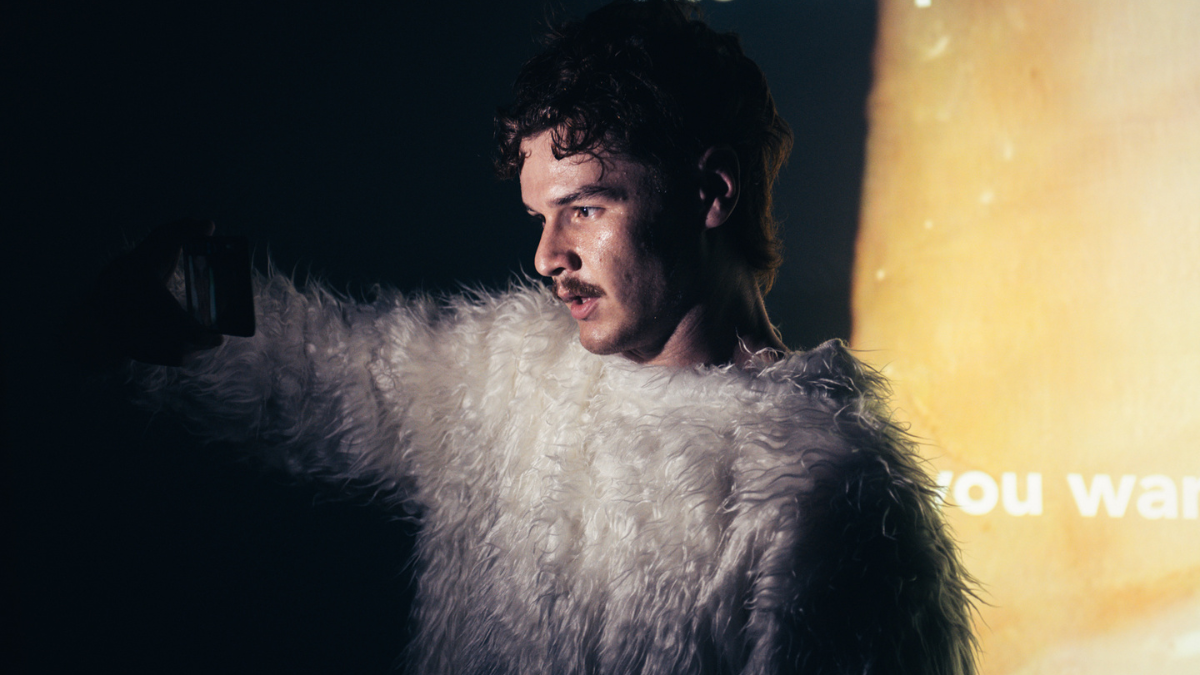
Entering Mark Haslam’s latest work, FAKE, is an experience in itself. A person in a Yeti suit sits at the bar of The Goodwill Club, staring down into a drink. Behind a screen is the dark, rectangular performance space with projections at each end and TVs along the sides. Mark sits in a cube in the centre, surrounded by screens, keyboards, and other miscellaneous objects. It feels like a den in here—a cool den, though, as Mark is playing great music.
As a curious and attentive audience member, I scan a QR code on one of the screens. It pops up with a question: “What do you know to be true?” This simple question is already too philosophical for me, and I’m paralysed with overthinking. People’s answers flash on the screen, ranging from factual observations like “We’re in The Rechabite” to inside jokes and, in true internet fashion, some questionable responses.
The work officially begins when Mark types messages to us that appear on the screen. It’s very reminiscent of The Matrix “Wake up, Neo…” scene. As he types, Mark explains that what we will see tonight is generated by what is currently posted and spoken about on the internet across multiple channels. It’s the internet with no algorithm.
What unfolds is a whirlwind of different experiences, each demanding our attention and involvement. Content fills all the screens at a rapid rate. A Cameo from a Kanye West impersonator gives a glowing endorsement of FAKE. While I’m looking at a screen at one end, I hear commotion behind me. The Yeti from the bar has appeared and is encouraging the audience to contribute to beating a piñata. It certainly gets the crowd amped up.

FAKE. Presented by kdmindustries.
There is scarce seating in the space, prompting you to get up and move around to view what’s unfolding from different angles. At times, our movement is forced, like when we play a game of True or False. To declare your response, you move to either side of the room labelled with “true” or “false.” Our host for this game is an amalgamation of Kanye, whose face and voice sit over Steve Harvey’s (as he hosts Family Feud). Even Snoop Dogg makes an appearance as a contestant. The statements start off pretty tame, like “Up is better than down,” before devolving into things we’d rather not state our opinions on in public. The crowd grows more hesitant, and we’re scolded by Kanye/Steve/Mark for not making choices. I wondered if we’d be just as reluctant to answer if we had the anonymity of the web to hide us.
I attended the show solo, but it was clear many people attended in groups or pairs. It made me realise that a lot of the time, our interactions with the internet are done in isolation. At times, it felt odd consuming this content with others around, like they’d come into my space. This feeling was particularly apparent when Mark introduced us to 4chan, an image-based site that rewards extreme imagery. Although our algorithms protect us most of the time from confronting and graphic images and videos, sometimes they sneak through. With 4chan, there is little to no moderation; no one is protected from what could be deemed harmful content. As unfiltered images whizz across the screens in front of us, we all stand in silence, stunned. The images are gone before we have a chance to discuss or verbally react; even if they were up for longer, would we have discussed them? What would we have said? Mark doesn’t leave us to dwell and provides a palate cleanser in the form of a Democracy Sock Puppet (I can’t explain).

FAKE. Presented by kdmindustries.
It’s hard not to give a play-by-play of all the impressive, interesting, and sometimes alarming things we’re shown in this show. It’s evident the production is technologically complex, and Mark is working hard throughout to gather what he needs and control the production like a puppet master. On top of that, he is at the centre of the show, actively contributing his own voice and appearance, at times being incredibly candid and vulnerable with the audience. It feels like a peek into his brain.
The conclusion of FAKE sees us all under examination. The Yeti returns and takes off his mask to reveal the human beneath (Shaun Johnston). He moves around the space with his iPhone, inspecting each face in the audience. The screens livestream his camera, and an AI tool morphs the audience’s faces into artistic depictions in various styles. Some people stare down the lens while others turn their faces away. Mark switches the camera to his own and prompts the AI to change his face into an “Old Man,” “Sad Old Man,” before ending with “Happy Old Man.” It’s a gentle and uplifting ending to this eccentric and striking work.
FAKE isn’t about the content we’re shown. While most of the time, I couldn’t quite comprehend the content I was seeing as it was so fleeting, I did notice an instant emotional reaction: disgust, anguish, amusement, sadness. Regardless of whether the content was “fake” or AI-generated, it didn’t take away my very real response.
Learn more about kdmindindustries.