


The door through which she left 15 years ago is the same one Nora re-enters through in Lucas Hnath’s A Doll’s House, Part 2. When we last saw Nora in Henrik Ibsen’s original 1897 A Doll’s House, she had made the divisive decision to leave her former life, husband, and children in pursuit of a life determined solely by herself. After enjoying over a decade of “freedom” and immense success as an author, she has returned to confront the ghosts of her former life and re-enter a similar but different battle to the one she left behind.
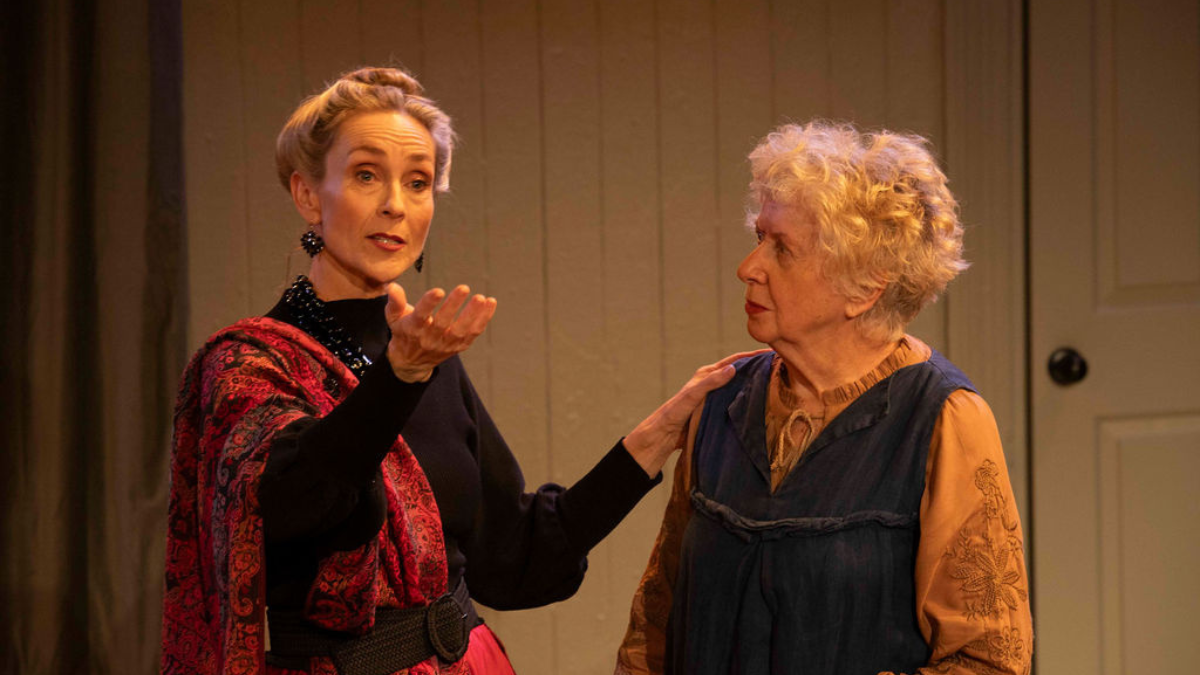
Alison van Reeken commands the room as Nora, a constant presence on stage for this 90-minute production, while the three other characters take turns rotating in debate-style conversations with her. First, it’s Nora versus Anne Marie, played by Julia Moody. There is an enveloping warmth and tenderness between them as they fill the gaps in time, allowing us to learn about Nora’s life since she left. While the play is rich in comedy throughout, this opening act certainly takes the cake, in large part thanks to Julia’s array of facial expressions, which left no one guessing what Anne Marie thought of Nora’s adventures. It’s been a while since I enjoyed such laugh-out-loud moments at the theatre.

A Doll’s House, Part 2. Stewart Thorpe Photography.
When Maitland Schnaars enters the space as the stern-faced Torvald, the energy shifts. The tension is rife between Nora and Torvald. Both Nora and the audience expect him to be angry and one-note, but what we don’t anticipate is the empathy Maitland elicits from us with his portrayal. We see a person who is confused, hurt, and abandoned—someone we can, in many ways, understand.
Lucas Hnath has written four distinctive characters, and this is driven home with the arrival of Nora’s daughter, Emmy, played by ‘Ana Ika. She was just a toddler when Nora left, and now she’s in her late teens or early twenties, with unbridled confidence and a level of delusion that only a person of that age can possess. The comedy of this script shines again in this act, where we shamefully enjoy ‘Ana’s slightly condescending tone as she addresses and “corrects” Nora like a toddler.

A Doll’s House, Part 2. Stewart Thorpe Photography.
The setting in which this all takes place is the entry room of Nora’s former home. It’s a transient environment, bare with just three chairs, two of which are covered for some time. There is no personality, familiarity, or home-like feeling in this space, and while it has elements of Regency style, the room could really be from any time. The design leans into this unidentifiable period; while we’re told it’s 15 years later, the conversations feel current. Lucas Hnath has used the original play as a neat vessel for debates on family, marriage, societal expectations, and love. This idea is driven home as Nora repeatedly states her optimism for the future, which she hopes will see more equality between men and women—a future that has not yet arrived and may never.

A Doll’s House, Part 2. Stewart Thorpe Photography.
This production is dense in dialogue, making it a marathon for Alison as Nora. However, she cruises through it with ease, always maintaining the sprightly and driven energy of her character with vigour. Even when we think Nora could be on the cusp of giving in or compromising, she pushes through with unrelenting determination. While Hnath’s writing is strong and entertaining, I’m grateful we had this cast and team delivering this text, as things could go awry in less experienced hands. The weight of the words is only fully brought to life with the brilliant physicality and delivery that this cast possesses.
Perhaps I’m easily convinced or malleable, but I was able to see both sides of the discourse which carries throughout the show. I found myself agreeing with Nora’s perceptions of the constraints and limitations of marriage while simultaneously enjoying Emmy’s optimistic and romanticised views. (As a celebrant, this was all very interesting to me.) Hnath proves that in the case of marriage, love, and family, there is really no moral compass we can use to guide us in our decision-making. We learn through Nora and the other characters that the right decision is the best one for ourselves. I love that Nora sticks to her guns and doesn’t relent to admitting regrets that she doesn’t truly feel. She did the impossible and put herself first, something we should all try.
A Doll’s House, Part 2 is presented by Red Ryder Productions and is on now at The Blue Room Theatre until June 29.